Someone should be watching your servers. Let it be us.
We manage, secure and monitor your Linux servers — Ubuntu, RHEL, CentOS/Rocky, Debian — with patching, hardening, uptime monitoring and 24/7 support. Senior sysadmins, fixed monthly scope, servers that are someone’s job to watch, not an afterthought.
180+ teams shipping with our engineers · ISO 27001-secure · NDA on request
— What we build
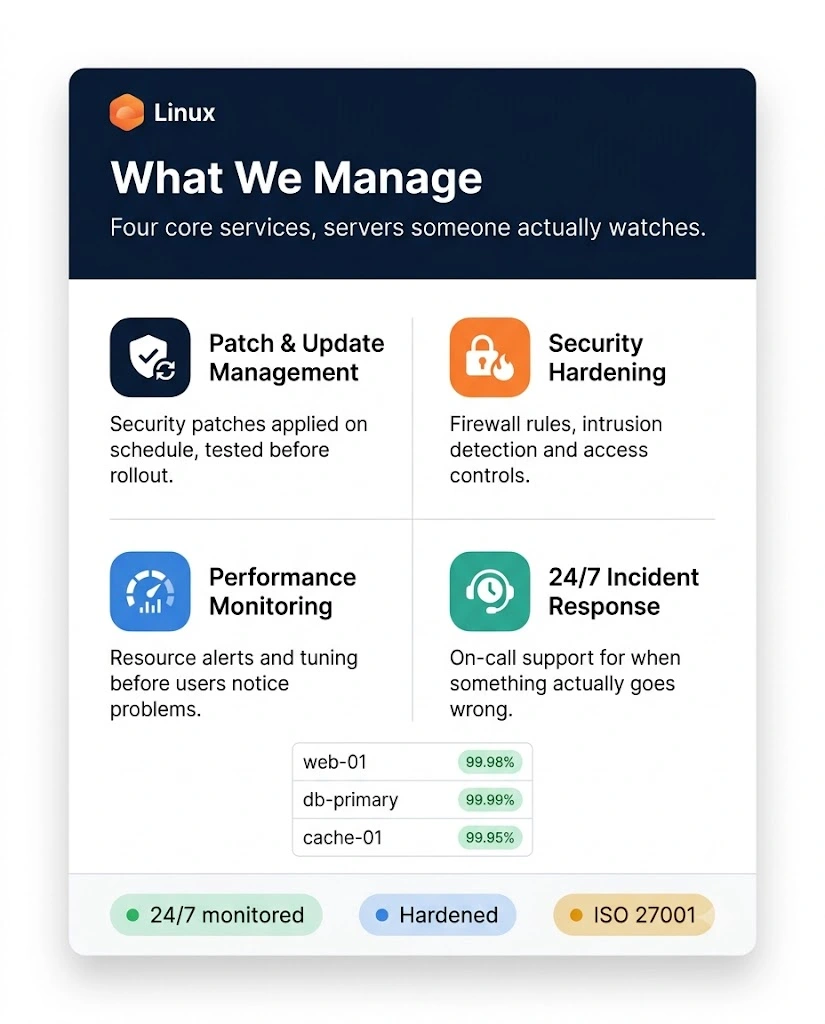
Four ways we manage your Linux servers.
From a single production server to a full fleet, we provide the ongoing administration that keeps servers patched, secure and monitored. (Need a one-time automation project or a cloud migration instead? See our Infrastructure Automation and Cloud Migration Services pages.)
Patch & update management
Security patches and OS updates applied on a schedule, tested before rollout, with a rollback plan if something breaks.
Scheduled patching
Kernel updates
Rollback-ready
Security hardening & monitoring
Firewall rules, intrusion detection, access controls and continuous monitoring so issues get caught before they’re incidents.
Firewall / fail2ban
Intrusion detection
Access hardening
Performance monitoring & tuning
Resource monitoring, alerting and tuning so servers run efficiently and problems get caught before users notice.
Uptime monitoring
Resource alerts
Performance tuning
24/7 incident response & support
On-call support for when something actually goes wrong — not a ticket queue that responds Monday morning.
24/7 on-call
Incident response
SLA-backed
- Featured · Servers that are someone's job
Most server incidents happen because nobody was actually watching.
Most “the server’s been unpatched for eight months” or “we didn’t notice disk space filling up” problems happen because server management is everyone’s part-time responsibility and nobody’s actual job. Before we take over anything, we audit the current state honestly — then make sure patching, monitoring and security are a recurring, accountable process, not a task on someone’s backlog.
Patched on schedule
Monitored 24/7
Hardened by default
Someone’s actual job
1
AUDIT
Assess current patch level, security & performance
2
HARDEN
Fix security gaps and configuration issues
3
MONITOR
Set up alerting and 24/7 coverage
Outcome
We start with a server audit — so you know exactly what state your fleet is really in before anything else.
14 years · 300+ PRODUCTS
Built to be watched,
not just running.
300+
Products shipped to production
across 9 industries
14yrs
Years in business
founded 2012
95%
Engagement extension
clients renew or expand
ISO 27001
Audited data security
brief → first standup






Capabilities & stack
Boring tech that
ships on time.
We manage servers with proven, widely-used tooling — not a bespoke monitoring stack only one person understands. Real operations, documented for accountability.
How we pick
01
Audit honestly before taking over
Before we manage anything, we assess the real patch level, security posture and performance — so you know the starting point, warts and all.
02
Patch on a schedule, tested first
Updates go through a staging check before production rollout, on a defined cadence — not applied ad hoc or skipped when things get busy.
03
Monitor continuously, not reactively
Alerting is set up for resource usage, security events and uptime — so problems get caught before a user complains.
04
Real accountability where it counts
Defined SLAs and on-call coverage for incidents — so “who’s responsible for this server” always has a clear answer.
LINUX DISTRIBUTIONS
Ubuntu
RHEL
CentOS / Rocky Linux
Debian
MONITORING & ALERTING
Datadog
Zabbix
Prometheus + Grafana
Nagios
SECURITY & HARDENING
UFW / iptables
fail2ban
CIS benchmarks
SSH hardening
PATCH & CONFIG MANAGEMENT
Unattended-upgrades
Ansible
apt / yum automation
BACKUP & RECOVERY
Automated backups
Disaster recovery planning
Snapshot management
Industries
Linux server management, tuned for your industry.
Every industry has its own uptime expectations, compliance requirements and tolerance for unpatched risk. We bring playbooks, not generic monitoring — and manage your servers around your organization’s real constraints from day one.
Healthcare
Server management that keeps clinical systems compliant.
- HIPAA-aligned hardening and access control
- Scheduled patching for systems that can't have surprise downtime
- 24/7 monitoring for compliance-critical infrastructure
Finance & Fintech
Server management built for regulatory audit requirements.
- Compliance-aligned hardening and patch documentation
- Continuous monitoring with audit-ready logs
- Incident response meeting regulatory reporting requirements
Retail & E-commerce
Server management that holds up during peak traffic.
- Performance monitoring tuned for seasonal traffic spikes
- Patch scheduling that avoids peak sales-period disruption
- 24/7 incident response for revenue-critical servers
Logistics
Server management for systems that run around the clock.
- 24/7 monitoring for always-on tracking and dispatch servers
- Hardened, patched infrastructure across distributed depots
- Fast incident response for time-sensitive operations
Engagement models
Pick how you want to
ship with us.
Three ways in — all senior sysadmins, all fixed against the uptime and security outcomes we agree on before we take over.
Fixed-scope
Server audit & hardening
Best when you’re not sure how exposed or out-of-date your servers actually are.
- Fixed scope, fixed price, fixed timeline
- Full patch level, security and performance audit
- A prioritized hardening and remediation roadmap
Most popular
Fixed-scope
Project-based build
Best for ongoing management of a defined server fleet.
- Monthly retainer, scoped to your fleet size
- Patching, monitoring, hardening and 24/7 incident response
- SLA-backed response times
- Monthly reporting on patch and security status
Embedded
Staff augmentation
Plug senior Linux sysadmins into your team.
- 8+ yr average, hand-picked, never on a bench
- Server hardening, monitoring and incident-response skills
- Direct line to your IT or infrastructure lead
FAQ
The questions
everyone asks before kickoff.
Not sure how exposed your current servers actually are? Book a 30-min call with a senior sysadmin.
Which Linux distributions do you support?
Ubuntu, RHEL, CentOS/Rocky Linux and Debian are our most common, but we work with most mainstream distributions — tell us what you’re running and we’ll confirm fit on the first call.
How do you know if our servers are actually secure right now?
We run a server audit covering patch level, open ports, firewall rules, access controls and known vulnerabilities — giving you a real picture instead of an assumption that “it’s probably fine.”
Will patching our servers cause downtime or break things?
Patches are tested in a staging environment before production rollout and applied on a scheduled maintenance window with a rollback plan — so updates happen reliably, not as a surprise outage.
What happens if a server goes down at 2am?
Our managed support includes 24/7 monitoring and on-call incident response with defined SLA response times — so it’s someone’s actual job to respond, not a ticket waiting for Monday morning.
Do you just monitor our servers, or actively fix problems too?
Both — monitoring and alerting catch issues, but our managed support includes actively resolving them, not just notifying you that something’s wrong and leaving it to your team.
We have a small number of servers — is this still worth it, or is it only for large fleets?We have a small number of servers — is this still worth it, or is it only for large fleets?
It’s worth it for a single production server that matters to your business just as much as for a large fleet — the risk of an unpatched or unmonitored server doesn’t scale down with server count.
Can you take over servers that are already in a messy or undocumented state?
Yes — we specifically start with an honest audit for exactly this reason, so we understand what we’re inheriting before making changes, rather than assuming a clean starting point.
If we bring server management in-house later, can we take over cleanly?
Yes — we maintain documentation and configuration as code wherever possible throughout the engagement, so a transition back in-house (or to another vendor) doesn’t start from zero.
ISO 27001-secure · Certified since 2020
Let's make your servers someone's actual job.
Send your brief — a senior sysadmin (not a sales rep) replies within 24 hours with an honest read on your current server state, and a fixed-scope plan for the fix.
- A 30-min scoping call with a senior sysadmin
- An honest security and patch-level audit
- A hardening and monitoring plan
- An SLA-backed support proposal — yours to review