Know it broke before your customer files a ticket.
We test APIs and integrations for contract accuracy, edge cases and failure handling — so a third-party change, a bad response, or a silent timeout gets caught by a test, not a support ticket. Senior QA engineers, fixed scope, integrations your team can trust are actually working.
180+ teams shipping with our engineers · ISO 27001-secure · NDA on request
— What we build
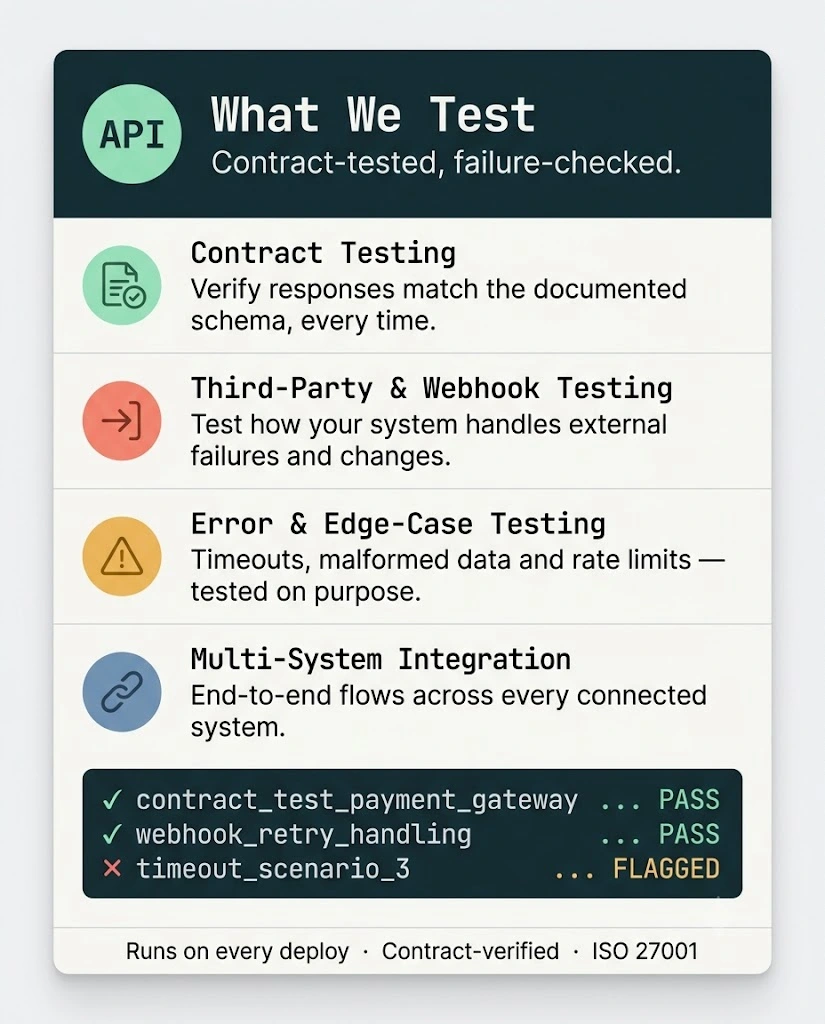
Four ways we test your APIs and integrations.
From a first contract test suite to full multi-system integration testing, we test the behavior that actually breaks in production — edge cases and failures, not just the happy path. (Need the API built, or load-tested under traffic instead? See our API Development & Integration and Performance & Load Testing pages.)
API contract testing
Verify that an API’s actual responses match its documented schema — so a silent breaking change gets caught immediately.
Schema validation
Contract testing
Breaking-change detection
Third-party & webhook testing
Test integrations with external APIs and webhook consumers, including how your system handles their failures and changes.
Third-party API testing
Webhook testing
Failure simulation
Error handling & edge-case testing
Deliberately test timeouts, malformed responses, rate limits and network failures — not just the successful request.
Timeout testing
Malformed data
Rate-limit handling
Multi-system integration testing
Test end-to-end flows across several connected systems, so a failure in one doesn’t silently corrupt data in another.
End-to-end flows
Cross-system validation
Data consistency checks
- Featured · Testing the failure, not just the success
Most integration bugs aren't in the happy path
they're in what happens when something goes wrong.
Most “the integration silently broke” incidents happen because testing only ever checked the successful case — nobody simulated what happens when the third-party API times out, returns malformed data, or changes its response format without warning. Before we call anything tested, we deliberately test the failure modes — because that’s where integrations actually break in production.
Failure modes tested
Contract-verified
Breaking changes caught
Runs on every deploy
1
MAP
Identify every integration point & its contract
2
TEST
Verify happy path, edge cases & error handling
3
AUTOMATE
Wire tests into CI/CD to run on every deploy
Outcome
We start with an integration map — so tests cover every point where your system depends on another one, not just the ones that are easy to test.
14 YEARS · 300+ PRODUCTS
Built to catch the silent break,
not just the loud one.
19+
Chatbots shipped
across 9 industries
14yrs
Years in business
founded 2012
95%
Engagement extension
clients renew or expand
<2wk
Kickoff time
brief → first standup






Capabilities & stack
Boring tech that
ships on time.
We test with proven, widely-adopted API testing tools — not a custom Postman collection only one person maintains. Real coverage, integrated into your release process.
How we pick
01
Map every integration point first
Before we write tests, we inventory every place your system depends on another API or service — many integration points are undocumented until someone maps them.
02
Test the failure, not just the success
A test suite that only checks the happy path misses where integrations actually break — we deliberately test timeouts, malformed responses and rate limits.
03
Validate the contract, not just the connection
A successful HTTP response doesn’t mean the data is correct — we validate response schemas against the documented contract, catching silent breaking changes.
04
Wire tests into every deploy
Integration tests run automatically in CI/CD, so a breaking change gets caught before it reaches production, not discovered by a customer.
API TESTING TOOLS
Postman / Newman
REST-assured
Karate
Insomnia
CONTRACT TESTING
Pact
JSON Schema validation
OpenAPI contract checks
MOCKING & SIMULATION
WireMock
MockServer
Third-party failure simulation
CI/CD INTEGRATION
GitHub Actions
GitLab CI
Automated regression suites
MONITORING & ALERTING
Datadog
Synthetic monitoring
Third-party API change detection
Industries
Integration testing,
tuned for your industry.
Every industry depends on different third-party systems, with different consequences when an integration silently fails. We bring playbooks, not generic test collections — and target testing at your organization’s real integration risks from day one.
Healthcare
Testing for integrations that carry patient data.
- Contract testing for EHR/EMR integration accuracy
- Failure-handling testing for clinical data exchange
- Regression testing to prevent care-critical integration breaks
Finance & Fintech
Testing for integrations where a silent failure costs money.
- Contract testing for payment and banking API integrations
- Failure-mode testing for transaction processing
- Regression testing for compliance-critical data flows
Retail & E-commerce
Testing for integrations that touch checkout and inventory.
- Contract testing for payment, shipping and tax APIs
- Failure-handling testing for inventory sync integrations
- Webhook testing for order-status update reliability
Logistics
Testing for integrations where a bad sync means a missed shipment.
- Contract testing for carrier and tracking API integrations
- Failure-mode testing for dispatch and routing integrations
- Regression testing across multi-carrier integration points
Engagement models
Pick how you want to
ship with us.
Three ways in — all senior QA engineers, all fixed against the reliability outcome we agree on before the first test is written.
Fixed-scope
Integration testing audit
Best when you’re not sure how much of your integration surface is actually tested.
- Fixed price, 1–2 weeks
- Full integration map and coverage gap analysis
- A prioritized test-suite roadmap
Most popular
Project-based build
Best for a defined set of APIs or integrations needing real coverage.
- live pipeline in 3–8 weeks
- Fixed scope, fixed price — no hourly drift
- Contract, error-handling and edge-case tests included
- Full test suite & CI integration handover
Embedded
Staff augmentation
Plug senior API testing engineers into your team.
- 8+ yr average, hand-picked, never on a bench
- Contract testing, mocking and CI integration skills
- Direct line to your engineering lead
FAQ
The questions
everyone asks before kickoff.
Not sure how much of your integration surface is actually tested? Book a 30-min call with a senior QA engineer.
What's the difference between API testing and integration testing?
API testing verifies an individual endpoint behaves correctly in isolation. Integration testing verifies that multiple connected systems work correctly together, including how failures in one propagate to another. We build both, since real production bugs often live in the gap between them.
A third-party API we depend on changed without telling us — could testing have caught that?
Yes — contract testing specifically checks that responses match the documented schema, so a silent breaking change from a third party gets flagged by a failing test instead of a confused support ticket.
Do you only test the "happy path," or do you test what happens when things go wrong?
We specifically prioritize testing failure modes — timeouts, malformed responses, rate limits, network errors — because that’s where most integration bugs actually happen, not in the successful case everyone already tests.
Can you test webhooks, or only request/response APIs?
Yes — webhook testing verifies your system correctly handles incoming events, including out-of-order delivery, retries, and malformed payloads from the sending system.
We have many microservices talking to each other — can you test all of it?
Yes — we test both individual service contracts and end-to-end flows across multiple services, checking that data stays consistent as it moves between them, not just that each service works in isolation.
Will these tests run automatically, or do we need to run them manually each time?
We wire integration tests into your CI/CD pipeline so they run automatically on every deploy — catching a breaking change before it reaches production, not after a customer reports it.
Can you test integrations with specific third-party services we already use?
Yes — we test whatever your system actually depends on, whether that’s a payment processor, a shipping carrier, a CRM, or an internal service, and simulate their failure modes specifically.
Who owns the test suite after handover, and can our team maintain it?
You own it, fully — test code, CI configuration, and documentation, with no vendor lock-in. We hand over everything your team needs to maintain and extend it as your integrations grow.
ISO 27001-secure · Certified since 2012
Let's find out what's actually untested.
Send your brief — a senior QA engineer (not a sales rep) replies within 24 hours with a read on your integration coverage gaps, and a fixed-scope plan for the test suite.
- A 30-min scoping call with a senior QA engineer
- An integration map and coverage gap analysis
- A contract and failure-mode test plan
- A test suite and CI integration — yours to keep