APIs that don't break the
moment someone else uses them.
We design, build and secure APIs — REST, GraphQL and webhook-based — and integrate with the third-party APIs your business already depends on. Documented, versioned, monitored. Senior engineers, fixed scope, an API layer your team and your partners can actually rely on.
180+ teams shipping with our engineers · ISO 27001-secure · NDA on request
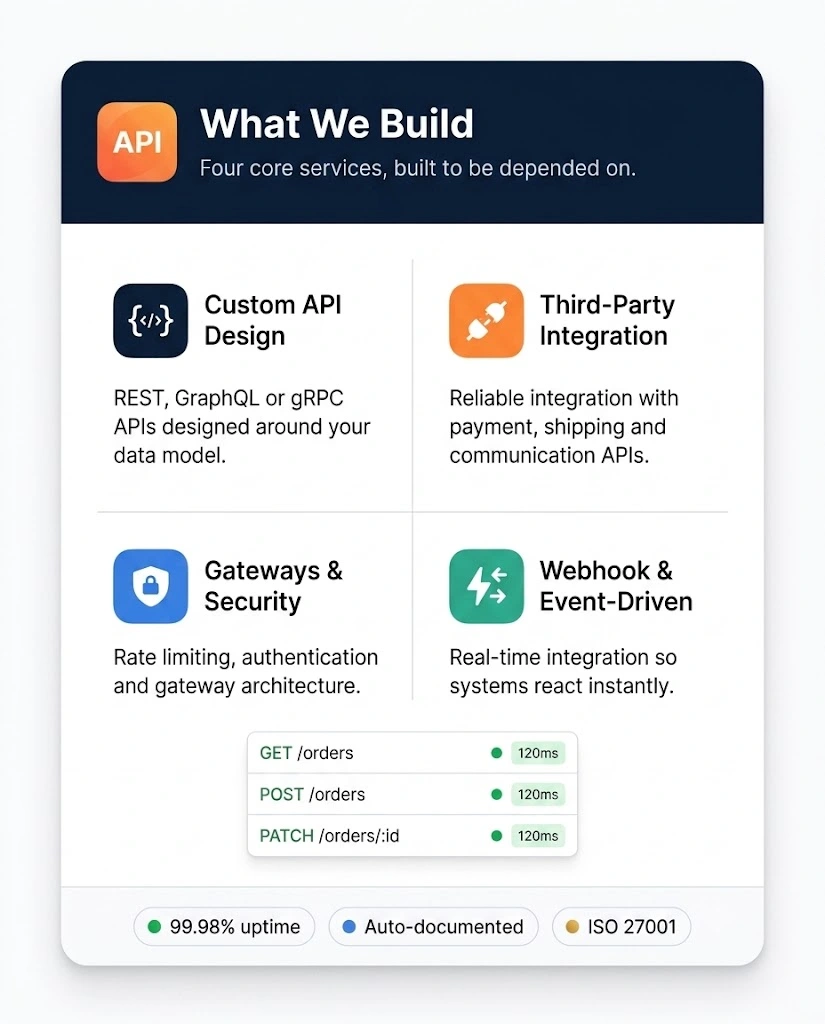
— What we build
Four ways we build and connect APIs .
From a new public API to a tricky third-party integration, we handle the API layer directly — designed to be documented, versioned and monitored from day one. (Need a full application built around the API, or CRM/AI-specific integration work? See our application and CRM/AI Integration pages.)
Custom API design & development
REST, GraphQL or gRPC APIs designed for your data model, versioned and documented from day one.
REST
GraphQL
OpenAPI docs
Third-party API integration
Reliable integration with payment, shipping, communication or industry-specific third-party APIs.
Payment APIs
Shipping / logistics
Communication APIs
API gateways & security
Rate limiting, authentication and gateway architecture so your APIs stay fast and safe under real traffic.
API gateway
OAuth / API keys
Rate limiting
Webhook & event-driven integration
Real-time, event-driven integration so systems react instantly instead of polling for updates.
Webhooks
Event-driven
Message queues
- Featured · Built to be depended on
Most broken integrations are
broken APIs, not broken code.
Most “the integration keeps failing” problems trace back to an undocumented, unversioned or unmonitored API — not the code calling it. Before we integrate with anything, we check what’s actually there — then design or fix the API layer so it can be depended on by more than one team, indefinitely.
Versioned by default
Documented automatically
Monitored in production
Built for more than one consumer
1
DESIGN
Model the data, define the contract
2
BUILD
Develop, secure and version the API
3
DOCUMENT
Auto-generate docs & example requests
Outcome
We start with an API contract and versioning plan — so the API can be depended on by more than one team without breaking.
14 years · 290+ bots
Built to be
depended on, not just working today.
300+
Products shipped to production
across 9 industries
14yrs
Years in business
founded 2012
95%
Engagement extension
clients renew or expand
ISO 27001
Audited data security
brief → first standup






Capabilities & stack
Boring tech that
ships on time.
We build APIs with proven protocols and gateway patterns — not a clever one-off that only the original developer understands. Real engineering, documented for whoever maintains it next.
How we pick
01
Design the contract first
Before we write a handler, we define the data model, versioning strategy and error format — so consumers know exactly what to expect, forever.
02
Document as you build, not after
Auto-generated docs (OpenAPI/Swagger) ship alongside the code, so documentation never drifts out of sync with reality.
03
Secure and rate-limit by default
Authentication, authorization and rate limiting are part of the initial design, not patched in after the first abuse incident.
04
Real infrastructure where it counts
API gateways, message queues and proper monitoring when a simple endpoint runs out of road for real production traffic.
API PROTOCOLS
REST
GraphQL
gRPC
WebSockets
DOCUMENTATION & CONTRACTS
OpenAPI / Swagger
Postman collections
JSON Schema
API versioning
GATEWAYS & SECURITY
Kong
AWS API Gateway
OAuth 2.0
API keys & rate limiting
EVENT-DRIVEN & MESSAGING
Webhooks
Kafka
RabbitMQ
AWS SQS/SNS
OBSERVABILITY
Datadog
Grafana
PagerDuty
Distributed tracing
Industries
APIs,
tuned for your industry.
Every domain has its own data sensitivity, third-party ecosystem and uptime expectations. We bring playbooks, not generic endpoints — and design the API layer around your industry’s realities from day one.
Healthcare
HIPAA-compliant APIs for clinical and patient data.
- FHIR-aware APIs for clinical system interoperability
- Encrypted, access-scoped patient data endpoints
- Audit-logged API access for compliance reviews
Finance & Fintech
APIs built for regulatory scrutiny and uptime.
- Payment and banking API integrations with strict security
- Rate-limited, audit-logged transaction endpoints
- Compliance-aligned API access control
Retail & E-commerce
APIs that connect storefronts, inventory and payments.
- Product catalog and inventory sync APIs across channels
- Payment, shipping and tax API integrations
- Webhook-driven order status updates
Logistics
APIs where the shipment status updates in real time.
- Carrier tracking and rate-shopping API integrations
- Webhook-driven exception and delivery status updates
- Dispatch and routing API layer for driver apps
Engagement models
Pick how you want to
ship with us.
Three ways in — all senior engineers, all fixed against the outcome we agree before the first endpoint ships.
Fixed-scope
API audit & roadmap
Best when your existing APIs are unreliable but you’re not sure why.
- Fixed scope, fixed price, fixed timeline
- Review of contracts, versioning, docs and monitoring gaps
- A fix-vs-build roadmap with clear priorities
Most popular
Fixed-scope
Project-based build
Best for a defined API or integration project.
- Scope → deploy in 3–10 weeks
- Fixed scope, fixed price — no hourly drift
- Built, documented and monitored from day one
- Full API documentation & handover
Embedded
Staff augmentation
Plug senior API and integration engineers into your team.
- 8+ yr average, hand-picked, never on a bench
- API design, security and gateway skills
- Direct line to your engineering lead
FAQ
The questions
everyone asks before kickoff.
Not sure whether you need a new API or a fix to an existing one? Book a 30-min call with a senior engineer.
What can you build in terms of APIs?
New REST, GraphQL or gRPC APIs designed around your data model, integrations with third-party APIs (payment, shipping, communication), API gateway and security setup, and webhook-based event-driven integration. In short: the API layer, built to be depended on by more than one team.
Our existing API keeps breaking things for whoever calls it — can you fix that without rebuilding it?
Often yes. Most unreliable APIs are missing versioning, documentation, or rate limiting — not fundamentally broken — so we audit first and fix what’s causing the instability before recommending a rebuild.
Do you build REST APIs, GraphQL, or both?
Both — the choice depends on your data shape and consumers. REST suits simple, resource-based access; GraphQL suits complex, nested data where consumers need flexible queries. We recommend based on your actual use case, not a default preference.
Can you integrate with a specific third-party API we already use (payment, shipping, etc.)?
Yes — we’ve built integrations with major payment processors, shipping carriers, communication platforms and industry-specific APIs, and we handle the authentication, rate-limiting and error-handling quirks each one has.
How do you make sure our API stays documented as it changes?
We use auto-generated documentation (OpenAPI/Swagger) that’s built alongside the code, so docs update automatically when the API changes — instead of drifting out of sync over time like hand-written docs do.
What happens if our API gets hit with more traffic than expected?
Rate limiting, caching and gateway architecture are part of the initial design, not an afterthought — so the API degrades gracefully under load instead of falling over.
How do you handle API security and authentication?
We implement OAuth 2.0, API keys, or other appropriate authentication schemes based on who’s consuming the API, with access scoped to what each consumer actually needs — not blanket access.
Who owns the API and its documentation after handover?
You own it. We build with proper version control, auto-generated documentation and monitoring dashboards, and hand over everything your team (or the next vendor) can pick up — no black box, no lock-in.
ISO 27001-secure · Certified since 2020
Let's build an API worth depending on.
Send your brief — a senior engineer (not a sales rep) replies within 24 hours with a read on what’s fixable in your current API setup, and a fixed-scope plan for the gap.
- A 30-min scoping call with a senior engineer
- A read on what's missing or fragile in your current API
- A fix-vs-build plan for the gap
- A documentation and monitoring plan — yours to keep