Modernize the system
not just its coat of paint.
We re-platform, re-architect or replace aging software — preserving years of business logic while removing the technical debt holding your team back. No “rip and replace” surprises, no lost history. Senior architects, fixed scope, a system built to run another decade.
180+ teams shipping with our engineers · ISO 27001-secure · NDA on request
— What we build
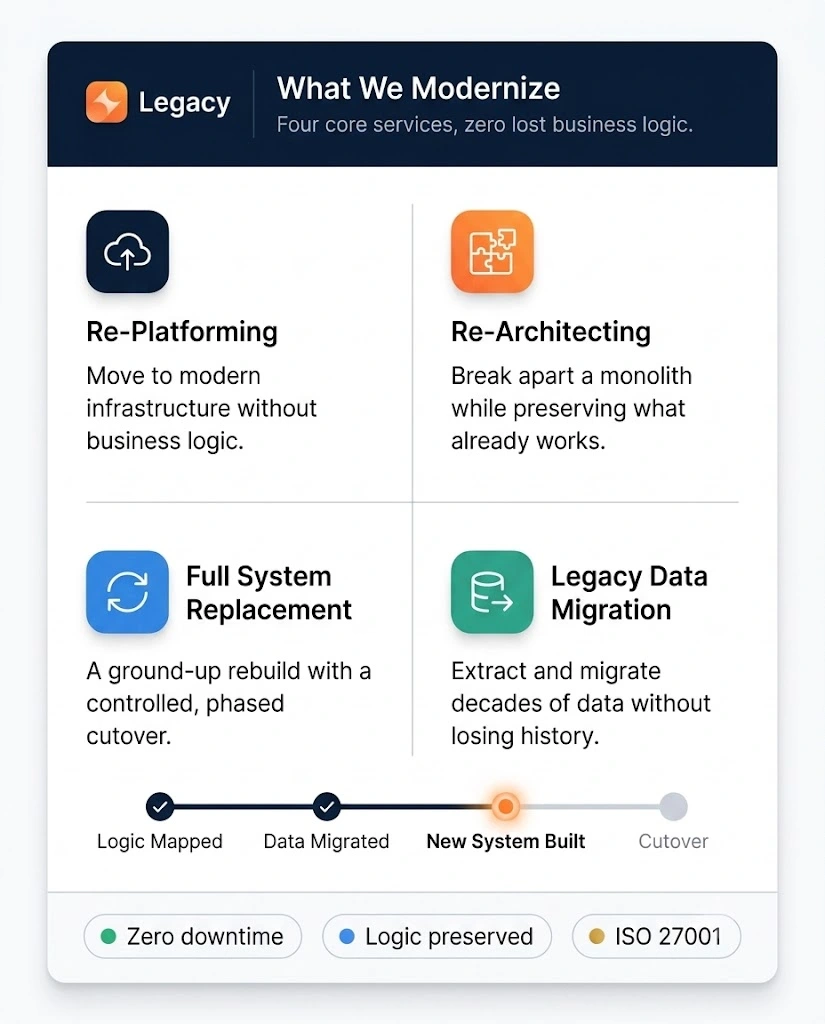
Four ways we modernize legacy systems.
From a targeted re-platform to a full system replacement, we choose the modernization path that matches your risk tolerance and timeline — never a rewrite for its own sake. (Building something brand new with no legacy system involved? See our Custom Software Development page.)
Re-platforming
Move the existing application to modern infrastructure — cloud, containers, current runtime — without rewriting the business logic.
Cloud migration
Containerization
Runtime upgrade
Re-architecting
Break apart a monolith into services, or restructure the codebase, while preserving what already works.
Monolith to microservices
Codebase restructuring
Incremental refactor
Full system replacement
When re-platforming won’t cut it — a ground-up replacement built around your actual current process, with a controlled cutover.
Ground-up rebuild
Phased cutover
Parallel run
Legacy data migration
Extract, clean and migrate decades of data out of legacy databases without losing history or breaking relationships.
Data extraction
Schema mapping
Historical data preservation
- Featured - Business logic first
The business logic in your legacy system is the
valuable part — not the code.
Most failed modernization projects fail because the team rewrote the system without fully understanding the business rules buried in twenty years of code — and lost critical edge cases in the process. Before we touch a single line, we map and document the business logic that actually matters, so the new system does everything the old one did, deliberately.
Map
Monitored by default
Alerting
No silent failures
1
MAP
Document the business logic that actually matters
2
PLAN
Choose re-platform, re-architect, or replace
3
BUILD
Develop and migrate in controlled phases
Outcome
We start with a business-logic audit — so the new system does everything the old one did, deliberately, not by accident.
14 years · 300+ PRODUCTS
Built to last another
decade, not just launch.
300+
Products shipped to production
across 9 industries
14yrs
Years in business
founded 2012
95%
Engagement extension
clients renew or expand
ISO 27001
Audited data security
brief → first standup






Capabilities & stack
Boring tech that
ships on time.
We modernize with proven migration patterns and modern, boring-on-purpose infrastructure — not a risky big-bang rewrite. Real engineering, applied to the system you already depend on.
How we pick
01
Map business logic before writing code
Before we design anything new, we document what the legacy system actually does — including the edge cases nobody remembers the reason for.
02
Choose the least risky path that works
Re-platform when the logic is sound but the infrastructure isn’t. Re-architect when the code needs restructuring. Replace only when nothing else will do.
03
Run old and new in parallel
Wherever possible, the new system runs alongside the old one, validated against real data, before we ever switch over.
04
Real engineering where it counts
Proper data migration tooling, automated testing against legacy behavior, and phased cutover plans — not a weekend migration and hope.
MODERNIZATION PATTERNS
Strangler fig pattern
Monolith decomposition
Parallel-run validation
APPLICATION & INFRASTRUCTURE
React / TypeScript
Node.js
.NET
Docker
Kubernetes
LEGACY & DATA MIGRATION
Mainframe/COBOL interfacing
SQL Server / Oracle migration
ETL pipelines
CLOUD PLATFORMS
AWS
Azure
GCP
Containerization & orchestration
TESTING & VALIDATION
Automated regression testing
Data reconciliation
Load testing
Industries
Legacy
modernization tuned for your industry.
Every industry has its own legacy footprint, compliance history and business rules baked into old code. We bring playbooks, not blank rewrites — and preserve what matters to your organization from day one.
Healthcare
Modernizing clinical and admin systems without disrupting care.
- Legacy EHR/EMR modernization with zero care disruption
- HIPAA-compliant data migration and audit trail preservation
- Business logic mapping for clinical workflow rules
Finance & Fintech
Modernizing core systems under regulatory scrutiny.
- Core banking system re-platforming with parallel-run validation
- Compliance-critical business rule preservation
- Legacy data migration with full audit reconciliation
Retail & E-commerce
Modernizing legacy commerce and inventory systems.
- Legacy POS and inventory system re-platforming
- Order history and customer data migration without loss
- Monolith-to-microservices for multi-channel scale
Logistics
Modernizing dispatch and tracking systems that can’t go down.
- Legacy TMS/WMS re-platforming with zero-downtime cutover
- Shipment and carrier history preserved through migration
- Business logic mapping for decades-old routing rules
Engagement models
Pick how you want to
ship with us.
Three ways in — all senior architects, all fixed against the outcome we agree before the first line of legacy code gets touched.
Fixed-scope
Legacy system audit
Best when you know something needs to change but not what approach fits.
- Fixed scope, fixed price, fixed timeline
- Business logic mapping and technical debt assessment
- A re-platform vs re-architect vs replace recommendation
Most popular
Fixed-scope
Project-based build
Best for a defined system with a clear modernization path.
- Scope → deploy in 12-24 weeks
- Fixed scope, fixed price — no hourly drift
- Parallel-run validation and phased cutover included
- Full documentation & handover
Embedded
Staff augmentation
Plug senior integration engineers into your team.
- 8+ yr average, hand-picked, never on a bench
- Legacy systems, migration and re-architecture skills
- Direct line to your CTO or engineering lead
FAQ
The questions
everyone asks before kickoff.
Not sure which modernization path fits your system? Book a 30-min call with a senior architect.
What's the difference between re-platforming, re-architecting and replacing a legacy system?
Re-platforming moves the existing application to modern infrastructure without changing the code. Re-architecting restructures the codebase or breaks apart a monolith while keeping the core logic. Replacing builds a new system from the ground up when the old one genuinely can’t be salvaged. We recommend based on an audit, not a default preference.
How do you avoid losing years of business logic that nobody fully understands anymore?
We start with a business-logic mapping phase — documenting what the system actually does, including edge cases — often by combining code analysis with interviews of long-tenured staff who remember why certain rules exist.
Can you modernize our system without taking it offline?
In most cases yes — we use phased migration patterns and run the old and new systems in parallel wherever possible, validating the new system against real data before switching over, so operations aren’t paused for the migration.
Our legacy system runs on a mainframe or an old language nobody uses anymore — can you still work with it?
Yes — we have experience interfacing with and migrating off mainframe/COBOL and other older platforms, extracting both the logic and the data safely.
How do you decide if it's worth modernizing at all versus just living with the old system?
Our legacy system audit gives you a clear picture of the technical debt, risk and cost of staying versus modernizing — so the decision is based on real tradeoffs, not urgency alone.
What happens to our data during the migration — is there a risk of losing history?
We treat legacy data migration as its own careful process — extraction, cleaning, schema mapping and reconciliation — specifically designed to preserve historical records and relationships, not just move the latest snapshot.
How long does a legacy modernization project usually take?
It depends heavily on scope and approach — a re-platform might take 8–12 weeks, while a full replacement with phased cutover can run 16–24 weeks or more. We share a fixed timeline after the audit, not a guess.
Who owns the modernized system, and can our team maintain it afterward?
You own it, fully — source code, infrastructure, and documentation, with no vendor lock-in. We hand over everything your team (or the next vendor) needs to maintain and extend it.
ISO 27001-secure · Certified since 2020
Let's modernize what's holding you back.
Send your brief — a senior architect (not a sales rep) replies within 24 hours with a read on your system’s real risk and complexity, and a fixed-scope plan for the path forward.
- A 30-min scoping call with a senior architect
- A business-logic and technical debt read
- A re-platform vs re-architect vs replace recommendation
- A phased cutover plan — yours to keep