Know about the problem before your customers do.
We monitor your cloud environment for threats, misconfigurations, compliance drift and cost anomalies — 24/7, with real alerts your team can act on, not noise they learn to ignore. Senior security engineers, fixed monthly scope, a cloud environment someone is actually watching.
180+ teams shipping with our engineers · ISO 27001-secure · NDA on request
— What we build
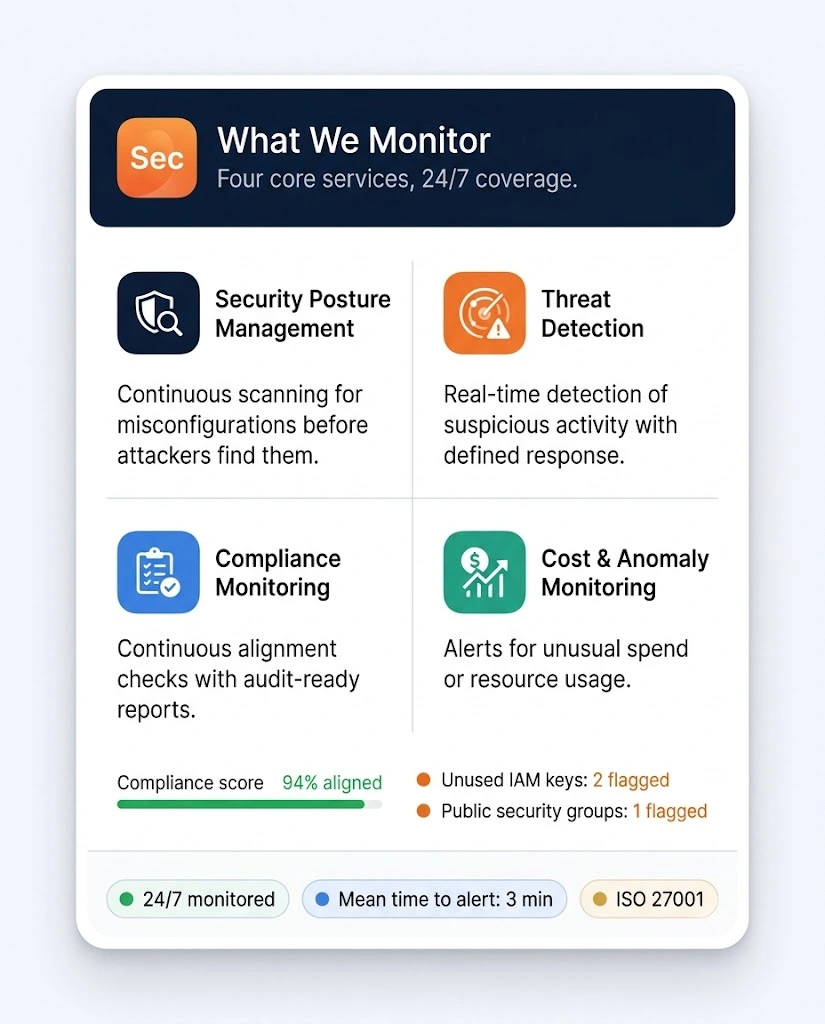
Four ways we secure and monitor your cloud.
From a first security posture audit to full 24/7 monitoring and compliance reporting, we build the ongoing coverage that matches your environment’s real risk. (Need the cloud foundation designed, or server-level administration instead? See our Cloud Architecture & Setup and Linux Server Management pages.)
Cloud Security Posture Management (CSPM)
Continuous scanning for misconfigurations — open storage, over-permissioned IAM, exposed ports — before an attacker finds them.
Misconfiguration scanning
IAM review
Exposure detection
Threat detection & incident response
Real-time detection of suspicious activity, with a defined response process when something actually happens.
Threat detection
SIEM
Incident response
Compliance monitoring & reporting
Continuous alignment checks against SOC 2, HIPAA or other frameworks, with audit-ready reports on demand.
Compliance dashboards
Audit-ready reports
Framework alignment
Cost & anomaly monitoring
Alerts for unusual spend or resource usage that often signal a security issue as much as a billing one.
Cost anomaly detection
Usage alerts
Budget monitoring
- Featured · Alerts your team actually acts on
Most cloud breaches aren't sophisticated they're a misconfiguration nobody was watching for.
Most cloud security incidents don’t involve an advanced attacker — they involve an open storage bucket, an over-permissioned key, or a security group left wide open, sitting unnoticed for months. Before we set up monitoring, we tune alerts to your actual environment — so your team gets a handful of real, actionable findings, not hundreds of alerts they learn to ignore.
Tuned to your environment
Actionable alerts
Compliance-mapped
No alert fatigue
1
AUDIT
Assess current security posture & exposure
2
TUNE
Configure monitoring to your real environment
3
DETECT
24/7 threat and misconfiguration monitoring
Outcome
We start with a security posture audit — so monitoring is tuned to your actual risk, not a generic alert template.
14 years · 300+ PRODUCTS
Built to catch it early,
not explain it after.
300+
Products shipped to production
across 9 industries
14yrs
Years in business
founded 2012
95%
Engagement extension
clients renew or expand
ISO 27001
Audited data security
brief → first standup






Capabilities & stack
Boring tech that
ships on time.
We monitor with proven, widely-adopted security tooling — not a bespoke alerting stack only one person can tune. Real coverage, documented for accountability.
How we pick
01
Audit exposure before monitoring
Before we configure alerts, we assess actual current exposure — open ports, permissive IAM, unencrypted storage — so we know what genuinely needs watching.
02
Tune alerts to reduce noise, not add to it
Alerting is configured specifically for your environment’s normal behavior — so real anomalies stand out instead of getting lost in false positives.
03
Map monitoring to compliance, not just security
Where a compliance framework applies, monitoring and reporting are mapped directly to its requirements — so audits become a report export, not a scramble.
04
Respond, don't just alert
Defined incident response playbooks and escalation paths mean an alert leads to action, not just a notification nobody owns.
CSPM & MISCONFIGURATION
AWS Security Hub
Azure Security Center
Prisma Cloud
THREAT DETECTION & SIEM
AWS GuardDuty
Azure Sentinel · Splunk
Datadog Security
COMPLIANCE & GOVERNANCE
SOC 2 / HIPAA mapping
CIS benchmarks
AWS Config / Azure Policy
COST & ANOMALY MONITORING
Cost Explorer / Azure Cost Management
Anomaly detection alerts
INCIDENT RESPONSE
PagerDuty
Runbook automation
Escalation workflows
Industries
Cloud security, tuned for your industry.
Every industry has its own threat model, compliance framework and tolerance for exposure. We bring playbooks, not generic dashboards — and tune monitoring to your organization’s real risk from day one.
Healthcare
Monitoring built for HIPAA and patient data protection.
- Continuous monitoring for PHI exposure risk
- HIPAA-aligned compliance dashboards and audit reports
- 24/7 threat detection for clinical system infrastructure
Finance & Fintech
Monitoring built for regulatory scrutiny and audit readiness.
- SOC 2-aligned continuous compliance monitoring
- Threat detection tuned for financial data environments
- Audit-ready reporting on demand for regulators
Retail & E-commerce
Monitoring that protects customer and payment data at scale.
- PCI-relevant misconfiguration scanning for payment systems
- Cost anomaly detection for seasonal traffic environments
- 24/7 monitoring across multi-region storefront infrastructure
Logistics
Monitoring for infrastructure that can’t afford a blind spot.
- 24/7 monitoring for always-on tracking and dispatch systems
- Misconfiguration scanning across distributed cloud environments
- Incident response tuned for time-sensitive operations
Engagement models
Pick how you want to
ship with us.
Three ways in — all senior security engineers, all fixed against the risk-reduction outcome we agree on before monitoring goes live.
Fixed-scope
Security posture audit
Best when you’re not sure how exposed your cloud environment actually is.
- Fixed scope, fixed price, fixed timeline
- Full misconfiguration, IAM and exposure assessment
- A prioritized remediation and monitoring roadmap
Most popular
Fixed-scope
Project-based build
Best for ongoing 24/7 coverage of a defined cloud environment.
- Monthly retainer, scoped to your environment size
- CSPM, threat detection and compliance monitoring included
- SLA-backed alert response times
- Monthly security and compliance reporting
Embedded
Staff augmentation
Plug senior cloud security engineers into your team.
- 8+ yr average, hand-picked, never on a bench
- CSPM, SIEM and compliance-mapping skills
- Direct line to your CTO or security lead
FAQ
The questions
everyone asks before kickoff.
Not sure how exposed your cloud environment actually is? Book a 30-min call with a senior security engineer.
What's the difference between cloud security and cloud monitoring?
Cloud security covers the protective and compliance layer — finding and fixing misconfigurations, access issues and vulnerabilities. Cloud monitoring covers the ongoing observability — alerting on threats, anomalies and performance issues as they happen. We provide both together because they overlap in practice, but they’re conceptually distinct.
How do we know how exposed our cloud environment actually is right now?
We run a security posture audit covering misconfigurations, IAM permissions, exposed resources and known vulnerabilities — giving you a concrete, prioritized list rather than a vague “you should improve security” statement.
We already get security alerts but ignore most of them — can you fix that?
Yes — most alert fatigue comes from generic, untuned alerting rules. We configure monitoring specifically to your environment’s normal behavior, so what reaches your team is a small number of real, actionable findings.
Can you help us pass a SOC 2 or HIPAA audit?
Yes — we map monitoring and compliance checks directly to the relevant framework’s requirements, so you have continuous evidence and audit-ready reports rather than scrambling to gather evidence right before an audit.
What happens if you detect an actual security incident?
We follow a defined incident response process — alerting your team immediately, helping assess scope and impact, and supporting remediation, rather than just sending a notification and leaving the response entirely to you.
Do you monitor for cost anomalies too, or just security threats?
Yes — unusual spend or resource usage patterns often signal a security issue (like compromised credentials being used to spin up resources) as much as a billing one, so we monitor both together.
We're a small team — is 24/7 monitoring realistic for us, or only for large companies?
It’s realistic for any team running production workloads — the point of managed monitoring is that you don’t need your own team watching dashboards at 3am; we do that so your team can focus on building.
Who owns the monitoring configuration and reports if we bring this in-house later?
You own it. We document configuration and provide exportable reports throughout the engagement, so transitioning to an in-house team or another vendor doesn’t mean starting from zero.
ISO 27001-secure · Certified since 2020
Let's find out what's actually exposed.
Send your brief — a senior security engineer (not a sales rep) replies within 24 hours with an honest read on your current exposure, and a fixed-scope plan for the fix.
- A 30-min scoping call with a senior security engineer
- An honest security posture and exposure audit
- A tuned monitoring and compliance plan
- An SLA-backed monitoring proposal — yours to review