Find the breaking point nbefore launch day does.
We load-test and stress-test your systems against real traffic targets — checkout flows, APIs, launches — so you know exactly how much load your system handles before it matters. Senior performance engineers, fixed scope, numbers you can actually plan capacity around.
180+ teams shipping with our engineers · ISO 27001-secure · NDA on request
— What we build
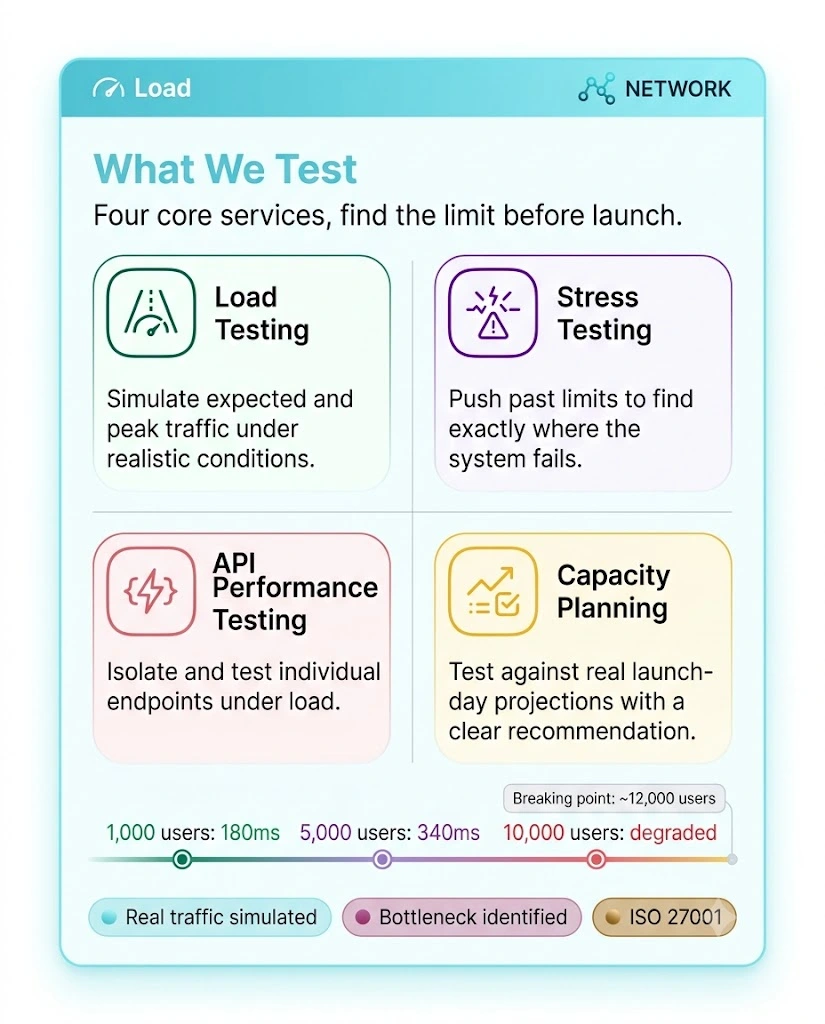
Four ways we test your system's limits.
From a targeted API load test to a full pre-launch capacity plan, we test against the traffic numbers that actually matter to your business. (Need the architecture fixed based on what testing reveals, or the infrastructure itself designed? See our Scalable System Architecture and Cloud Architecture & Setup pages.)
Load testing
Simulate expected and peak traffic to measure response times, throughput and error rates under realistic conditions.
Realistic traffic simulation
Throughput testing
Response-time measurement
Stress & breaking-point testing
Push the system past its expected limits to find exactly where and how it fails — before a real spike does it for you.
Breaking-point discovery
Failure-mode analysis
Extreme load
API & endpoint performance testing
Isolate and test individual API endpoints under load, so you know which specific calls are the bottleneck.
Endpoint-level testing
Latency profiling
Bottleneck isolation
Pre-launch & capacity planning
Test against your actual launch-day or campaign-day traffic projections, with a clear go/no-go recommendation.
Launch-readiness testing
Capacity planning
Go/no-go reporting
- Featured · Real numbers, not a guess
Most launch-day outages happen because nobody tested for the traffic that actually showed up.
Most “the site went down on launch day” incidents happen because load testing, if it happened at all, used generic traffic patterns instead of the numbers marketing was actually expecting. Before we test anything, we get your real projected numbers — expected users, peak concurrency, campaign timing — and test against those specifically, so the result is a plan, not a guess.
Real traffic targets
Breaking point found
Bottleneck identified
Go/no-go clarity
1
DEFINE
Get your real traffic targets & scenarios
2
SIMULATE
Run realistic load against those targets
3
STRESS
Push past limits to find the breaking point
Outcome
We start with your real traffic targets — so the test result is a specific number you can plan around, not a generic pass/fail.
14 YEARS · 300+ PRODUCTS
Built to find the limit
before your users do.
19+
Chatbots shipped
across 9 industries
14yrs
Years in business
founded 2012
95%
Engagement extension
clients renew or expand
<2wk
Kickoff time
brief → first standup





Capabilities & stack
Boring tech that
ships on time.
We test with proven, widely-adopted load-testing tools — not a custom script that only simulates traffic in one narrow way. Real numbers, reproducible on the next test run.
How we pick
01
Start with your real numbers
Before we run a single test, we get your actual expected traffic — launch projections, historical peak data, campaign targets — not a generic “test at high load” default.
02
Simulate realistic user behavior
Load tests model actual user flows — browsing, checkout, search — not just hammering a single endpoint, since real traffic doesn’t behave that way.
03
Find the breaking point deliberately
We push past the expected target to find where and how the system actually fails, so you know your real ceiling, not just whether you clear the bar you set.
04
Report bottlenecks, not just a pass/fail
Results identify the specific component that limits capacity — database, API, cache — not just a green or red checkmark.
LOAD TESTING TOOLS
k6
JMeter
Locust
Gatling
API & ENDPOINT TESTING
Postman / Newman
Artillery
custom endpoint harnesses
MONITORING DURING TESTS
Datadog
Grafana
CloudWatch
Distributed tracing
INFRASTRUCTURE SIMULATION
Cloud-based load generation
Multi-region traffic simulation
REPORTING & ANALYSIS
Bottleneck analysis
Capacity planning models
Go/no-go reports
Industries
Performance testing, tuned for
your industry.
Every industry has its own traffic patterns, peak periods and cost of downtime. We bring playbooks, not generic load scripts — and test against your organization’s real peak scenarios from day one.
Healthcare
Performance testing for systems that can’t slow down under pressure.
- Load testing for patient portal and scheduling systems
- Stress testing for systems during high-demand periods
- Capacity planning for compliance-critical infrastructure
Finance & Fintech
Performance testing for transaction-critical systems.
- Load testing for payment and transaction processing systems
- Stress testing for market-event traffic spikes
- Capacity planning for regulatory reporting deadlines
Retail & E-commerce
Performance testing for the traffic that actually matters.
- Load testing for checkout flows ahead of major sales events
- Stress testing to find the real breaking point before Black Friday
- Capacity planning for flash-sale and campaign traffic
Logistics
testing for systems that run under constant load.
- Load testing for real-time tracking and dispatch systems
- Stress testing for peak shipping-season volume
- Capacity planning for carrier API integration traffic
Engagement models
Pick how you want to
ship with us.
Three ways in — all senior performance engineers, all fixed against the capacity target we agree on before the first test runs.
Fixed-scope
Performance baseline test
Best when you need a quick read on current capacity before deciding on a bigger engagement.
- Fixed price, 1–2 weeks
- Load test against current expected traffic
- A baseline report with clear bottleneck findings
Most popular
Project-based build
Best for a defined launch, campaign or capacity-planning need.
- live pipeline in 3–8 weeks
- Fixed scope, fixed price — no hourly drift
- Load, stress and breaking-point testing included
- Full report with go/no-go recommendation
Embedded
Staff augmentation
Plug senior performance engineers into your team.
- 8+ yr average, hand-picked, never on a bench
- Load testing, profiling and capacity-planning skills
- Direct line to your engineering lead
FAQ
The questions
everyone asks before kickoff.
Not sure what traffic numbers to test against? Book a 30-min call with a senior performance engineer.
What's the difference between load testing and stress testing?
Load testing measures how the system performs at expected or peak traffic levels. Stress testing deliberately pushes past those levels to find where and how the system actually breaks. We usually recommend both — load testing tells you if you’re ready, stress testing tells you your real ceiling.
We don't have a clear traffic projection — can you still help us test?
Yes — we help you define reasonable target numbers based on historical data, comparable launches, or industry benchmarks if you don’t have your own projections yet, so the test still has a meaningful target.
Can you test our APIs specifically, or only full user flows?
Both — we can isolate and load-test individual API endpoints to find which specific calls are the bottleneck, or test full realistic user journeys (browsing, checkout) that combine multiple endpoints the way real traffic does.
How do you make sure the test traffic behaves like real users, not just a simple script hammering one page?
We model realistic user behavior — varied paths, think-time between actions, mixed request types — rather than a uniform load pattern, since real traffic doesn’t hit a system the same way every time.
What happens after the test — do you just give us a report, or help fix what's found?
We deliver a report identifying specific bottlenecks (database, API, cache, etc.) with a clear go/no-go recommendation. If you need the underlying architecture or infrastructure fixed based on findings, we can continue through our Scalable System Architecture or Cloud Architecture & Setup pages.
How close to our actual launch date should we run performance testing?
Early enough to fix what’s found — typically several weeks before launch, so there’s time to address bottlenecks, not just document them the week before go-live.
Can you test a system that's still in staging, or does it need to be fully live?
Yes — RAG evaluation needs to test both the retrieval step (did it find the right source documents) and the generation step (did the model actually use them correctly), since a failure in either stage produces a wrong answer for different reasons.
Do we get to keep the test scripts and results for future testing?
Yes — you own the test scripts, configuration and full results, so future load tests (before the next big launch or campaign) don’t have to start from scratch.
ISO 27001-secure · Certified since 2012
Let's find your breaking point before your users do.
Send your brief — a senior performance engineer (not a sales rep) replies within 24 hours with a read on your testing needs, and a fixed-scope plan for the test.
- A 30-min scoping call with a senior performance engineer
- Help defining realistic traffic targets
- A load and stress testing plan
- A bottleneck report and test scripts — yours to keep