Custom Manufacturing Software Development Guide
What to build vs buy, the integration patterns that survive audit, the compliance layers most vendors miss, realistic budgets and timelines, and the questions to ask before signing any development statement of work.
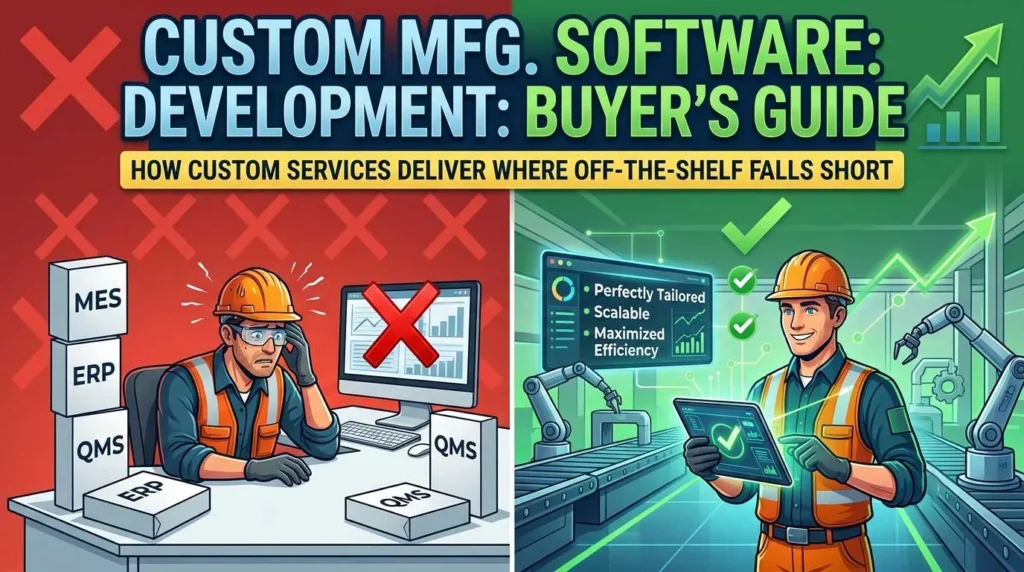
Custom manufacturing software belongs at the edges — integration layers, plant-specific workflows, equipment connectivity, analytics, and customer portals — not as a rebuild of commercial MES or ERP. Build when a requirement is a competitive differentiator or no product covers your regulatory/workflow specifics; configure commercial software for everything else. The three cost drivers that decide success: integration count, data quality, and change management. Never roll out to more than one line without a proven pilot.
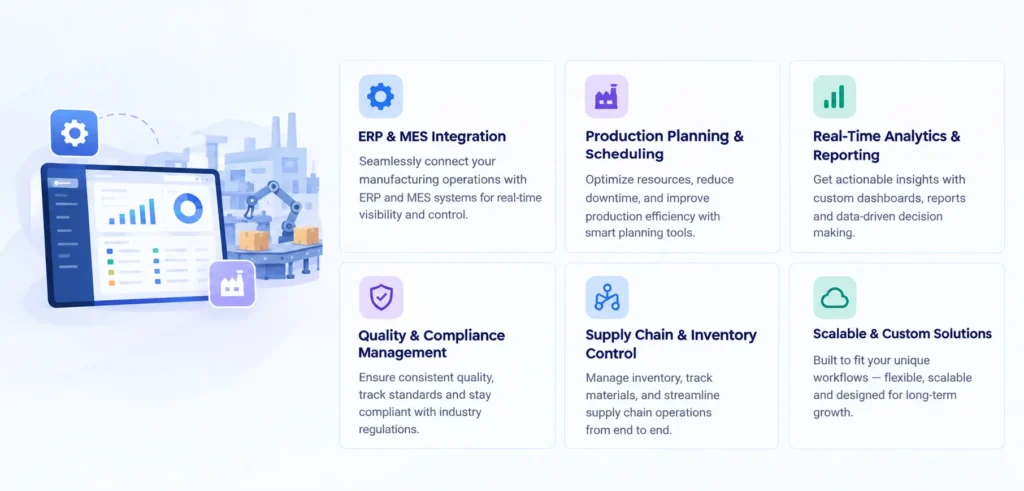
Manufacturing IT spending has quietly become the most complex domain in enterprise software. A modern mid-market manufacturer runs somewhere between 15 and 40 discrete systems: an ERP implemented over three years, an MES closer to a decade old, a WMS bundled with a 3PL contract, IIoT platforms per plant, quality and compliance tools, and dozens of Excel workbooks holding the business together in the gaps.
Commercial vendors would prefer to sell each manufacturer a single unified platform. Manufacturers know this is a fantasy. Every plant has quirks, every customer contract adds a compliance requirement, and every machine speaks a slightly different protocol. Custom manufacturing software development exists because the last 20–30% of any manufacturer’s requirements will never be met off the shelf — and that 20% is often where the competitive advantage lives.
What "custom manufacturing software" actually means
The term gets used loosely. In practice, custom software development for manufacturing falls into five distinct categories, each with different economics and different partner requirements. Confusing them is the most common cause of failed projects — a firm excellent at ERP integrations may be poor at IIoT edge development, and vice versa.
01
Integration layers between systems
~60% of custom budgets. Master-data sync, event forwarding, reconciliation, and workflows spanning ERP, MES and WMS boundaries.
3–6 months · 1–2 devs + integration architect
02
Plant-specific workflow apps
Automate a workflow too specialised or too small for commercial licensing — barcode receiving, supplier portals, legacy CNC operator interfaces, compliance reporting.
4–9 months
03
IIoT & equipment connectivity
Plant-specific adapters, edge processing, and analytics pipelines. Ranges from thin protocol adapters to full digital-twin implementations.
Weeks → 12–24 months
04
Analytics, predictive maintenance & quality
Modelling, feature engineering, and domain-specific ML that turns machine data into decisions. Needs data engineers, ML engineers, and SMEs.
6–18 months
When custom beats off-the-shelf
There is no shortage of commercial manufacturing software. So when does custom actually earn its cost? Six scenarios, in order of frequency:
- Legacy system integration. Oracle EBS from 2011, Rockwell MES from 2015, a bespoke WMS a predecessor built — no commercial iPaaS covers this specific combination.
- Equipment older than the software market. A 1998 CNC controller has no REST API; a 2003 PLC needs an edge device to parse serial output. Custom bridges the OT/IT divide.
- Workflows that reflect competitive advantage. If how you route work orders across cells is what makes throughput higher, encoding it in a COTS system leaks the advantage.
- Compliance-specific reporting. ISO 9001, IATF 16949, AS9100, ISO 13485, FDA 21 CFR Part 820 — auditors want specific reports with specific data lineage.
- Customer-specific requirements. A major OEM mandates a supplier portal to their spec; building the capability directly is often faster than six months of licensing workarounds.
- Analytics that require your domain knowledge. No product knows why Machine 7 behaves differently on the third shift, or why yield drops above 65% humidity.
If none of these six fits, you probably do not need custom development. Configure the commercial system properly and move on. If two or more apply, custom manufacturing software development services are worth the investment.
Integration patterns that survive audit
Manufacturing integrations live or die on discipline. Three patterns cover 90% of real-world scenarios:
Event-driven messaging connects real-time systems — machine events flow via MQTT to an edge broker, get enriched, then forward to Kafka where MES, historian, and analytics consumers subscribe. API-based synchronisation covers cloud SaaS and modern on-prem systems (REST, GraphQL, gRPC; ISA-95 B2MML and OAGIS BOD schemas). File-based batch exchange remains common for older systems — treat it as a fallback, not a primary pattern.
Any conversation with a manufacturing software consultant should include specific answers to: how do you handle idempotency when the same message arrives twice? How do you reconcile when the ERP and the MES disagree? How do you recover after a broker outage? Vague answers here mean the team has not run production integrations at scale.

Cost drivers and realistic budgets
Development services for manufacturing vary by scope, geography, and partner seniority. Rough 2026 ranges:
| Project shape | Realistic budget (USD) | Timeline |
|---|---|---|
| Single integration between two systems | $80K – $250K | 3 – 6 months |
| Plant-specific workflow application | $150K – $500K | 4 – 9 months |
| IIoT platform, single plant | $200K – $800K | 6 – 12 months |
| Custom analytics / predictive maintenance | $300K – $1.2M | 9 – 15 months |
| Customer-facing portal | $200K – $700K | 6 – 9 months |
| Multi-plant integration programme | $1M – $5M+ | 12 – 24 months |
| Full bespoke MES or WMS | $2M – $10M+ | 18 – 36 months |
The single biggest cost driver is integration count. Adding one more system rarely adds 20% — it usually adds 40–60%, because each integration has its own quirks, auth model, failure modes, and change-window constraints. The second is data quality: cleansing and reconciliation typically consume 30–40% of an analytics project’s budget. The third is change management: budget 15–25% for training, workflow redesign, and post-launch support.
The four disciplines that matter
If you internalise nothing else: every successful project we’ve delivered got these right; every failed one skipped at least one.
- Instrument from day one. Structured logs, health checks, business metrics — observability in place before the first production release, not bolted on after.
- Design for graceful degradation. Queue messages locally, retry with backoff, alert on threshold breaches, and never lose data silently.
- Test with representative data. Synthetic data misses the edge cases that break production. Use de-identified real data whenever legally possible.
- Version everything. Config, schema, deployment topology, integration endpoints — system state at any point must be reconstructible from source control.
How ZonSource approaches manufacturing software
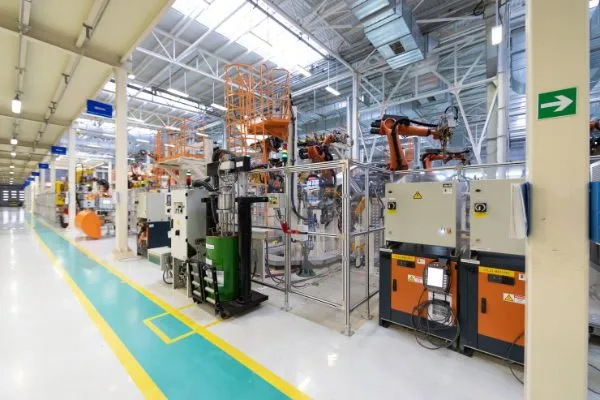
We work primarily with mid-market manufacturers across automotive, industrial equipment, food and beverage, and CPG. Every engagement begins with a two-week discovery sprint that documents the existing landscape, quantifies the integration debt, and identifies the highest-value custom development opportunities. Our engineers have prior experience at automotive Tier-1 suppliers, food-and-beverage plants, and industrial IoT platform vendors — so we bring the vocabulary and shop-floor intuition manufacturers actually need.
Where a hire model fits better than a project engagement, we also place manufacturing software developers on dedicated contracts — sometimes a plant needs three engineers for eighteen months, not a fixed-scope build. If you are scoping an MES integration, a custom quality portal, a predictive-maintenance pipeline, or a bespoke platform, book a 30-minute discovery call and we’ll send our reference architecture and case-study shortlist for your vertical in advance.
Frequently asked questions
What is custom manufacturing software development?
The design, build, and deployment of bespoke software that addresses requirements no off-the-shelf product covers — typically integration between existing systems, plant-specific workflows, equipment connectivity, predictive analytics, or customer-facing portals. It complements rather than replaces commercial MES, ERP, and WMS platforms.
When should a manufacturer choose custom over off-the-shelf?
Choose custom when the requirement is a competitive differentiator, when no commercial product covers your regulatory or workflow specifics, or when integration between existing systems is more critical than the systems themselves. Choose off-the-shelf when the requirement is a commodity capability your competitors also need.
How much do manufacturing software development services cost ?
A single integration project typically runs $80,000–$250,000 over 3–6 months. A custom workflow application runs $150,000–$500,000 over 4–9 months. Multi-plant integration programmes run $1M–$5M+ over 12–24 months. Bespoke MES or WMS implementations start at $2M and can exceed $10M.
How long does custom manufacturing software development take?
A focused integration project takes 3–6 months. A custom application typically takes 6–12 months from kickoff to go-live. Multi-plant rollouts take 12–24 months. Bespoke MES or full production systems take 18–36 months. Always plan a 60–90 day pilot phase before broad rollout.
What technology stacks are used in modern manufacturing software?
Backend: Python (analytics, integration), Java and C# (enterprise services), Node.js (real-time), Go (infrastructure). Messaging: MQTT, Kafka, RabbitMQ. Databases: PostgreSQL for transactions, TimescaleDB or InfluxDB for time-series machine data, Snowflake or Databricks for analytics. Cloud: AWS IoT, Azure IoT, GCP Cloud Run. Edge: NVIDIA Jetson, Advantech, and Siemens IPC platforms.