Dedicated Team vs Staff Augmentation vs Project Model
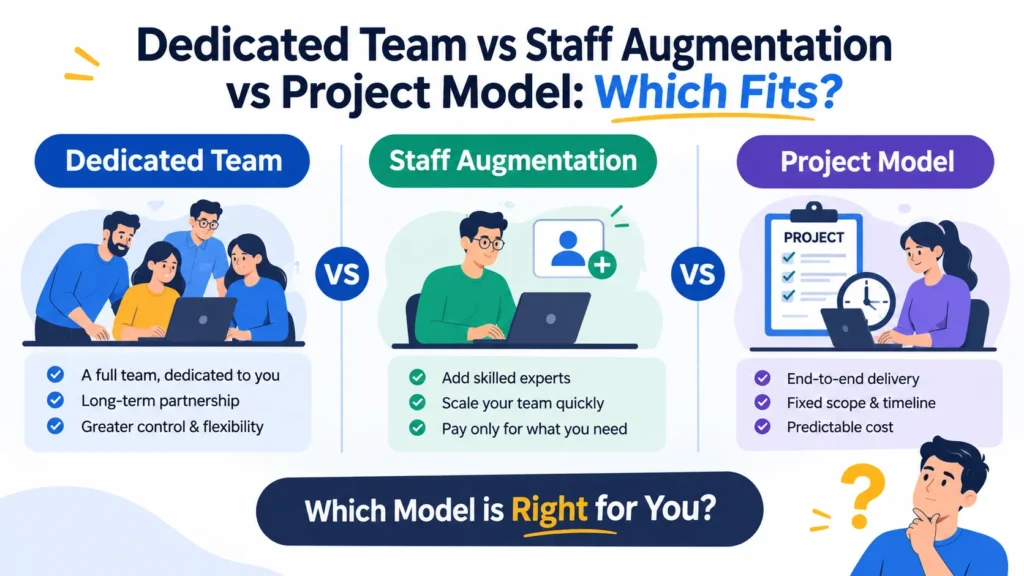
Dedicated Team vs Staff Augmentation vs Project Model: Which Fits?
Short answer: Choose staff augmentation when you have a clear gap and want to keep control of the work. Choose a dedicated team when the product will run for a long time and you want a stable group that owns delivery with you. Choose a fixed-scope project when the outcome is well defined and you want the vendor to own execution and timeline. Most of the mistakes companies make come from picking the model by price rather than by who needs to manage the work.
Engagement models
The three models in plain terms
Three ways to work with us — all senior architects, all sprint-based, all measured against the outcomes we agree on before kickoff.
Staff augmentation
Staff augmentation means adding engineers to your team. They work in your tools, report to your engineering manager, and follow your priorities. You pay per person, usually monthly or hourly. You handle planning, code review and day-to-day direction. This is the fastest way to add a specific skill, such as a Java developer who knows your legacy system.
A dedicated team
A dedicated team is a stable group, often with a lead and a mix of developers, QA and sometimes a designer, who work on your product for months or years. The vendor manages hiring, continuity and much of the delivery process. You set the product direction and priorities. You usually pay a fixed monthly fee for the team.
A fixed-scope project
A fixed-scope project means you agree on a defined deliverable, such as a migration, an integration or a feature set, with an agreed timeline and budget. The vendor plans and delivers the work. You review progress at set milestones. You need strong requirements up front, because changes after signing cost time and money.
ENGAGEMENT MODELS
Which model fits your project?
Staff augmentation, dedicated teams and fixed-scope projects solve different problems. Compare them on the factors that matter most to your product.
| Factor | Staff augmentation | Dedicated team | Fixed-scope project |
|---|---|---|---|
| Who manages the work | You | Shared | The vendor |
| Best for | Filling a skill gap | Long-running products | Defined outcomes |
| Scope | Flexible | Flexible, with a roadmap | Fixed up front |
| Typical pricing | Per person | Monthly team fee | Agreed price or milestones |
| Time to start | Fastest | Medium (setup and onboarding) | Medium (requirements first) |
| Team continuity | Depends on you | High | Ends at delivery |
| Knowledge stays with | Your team | The team and you | Mostly the vendor, unless handed over |
| Main risk | Management load | Cost if the roadmap stalls | Scope changes and rework |
Speed to start vs speed over time
Staff augmentation usually starts fastest, because you add people into an existing process. Dedicated teams take longer to set up, but they often deliver more per sprint after the first few months, because the team already knows the product. Fixed-scope projects need time for requirements, but once they start, the vendor runs the plan.
When you ask a vendor for a shortlist, check how long it takes and what it includes. Ask for the same answer from each vendor, so you can compare like with like.
Comparing cost correctly
Comparing hourly rates misleads. Compare the total cost of the outcome, which includes:
- Management time. Staff augmentation puts planning, reviews and day-to-day direction on your team. That time has a cost, even though it does not appear on the vendor invoice.
- Onboarding. Every new engineer needs time to learn your codebase. Dedicated teams spend this time once. Staff augmentation spends it again each time people change.
- Turnover and knowledge loss. When a person leaves, the knowledge leaves with them. Dedicated teams reduce this risk because the team, not one person, carries the knowledge.
- Rework. Fixed-scope projects can look cheapest until scope changes are added. Ask how change requests are priced before you sign.
A simple test: list the internal hours each model will need from your leads each month. Add that to the vendor cost. Compare the totals.
14+
Years of Expertise

290+
Satisfied Clients
96%
Client Repetition Ratio
750+
Project Completed
“ZonSource took our idea for a customer app from a rough sketch to a live, polished product on both stores — in weeks, not quarters.”
ST
Sanjay Talwar
Vice President · Alaska Data Solutions
Speed to start vs speed over time
Staff augmentation usually starts fastest, because you add people into an existing process. Dedicated teams take longer to set up, but they often deliver more per sprint after the first few months, because the team already knows the product. Fixed-scope projects need time for requirements, but once they start, the vendor runs the plan.
When you ask a vendor for a shortlist, check how long it takes and what it includes. Ask for the same answer from each vendor, so you can compare like with like.
Frequently Asked questions, answered.
No model is best for every project. Start with the scope, the timeline and who will manage the work. Answer those, and the right model is usually clear. If you are not sure, tell us what you are building and we will help you choose.
Is staff augmentation cheaper than a dedicated team?
Not always. Staff augmentation can cost less for a short, specific need. A dedicated team can cost less over a long product life, because onboarding and management overhead are shared across the team. Compare total cost, not monthly fees.
Which model is better for a startup?
Startups with a clear, short-term need often start with staff augmentation or a fixed-scope project. Startups building a product over a longer period often benefit from a dedicated team, once the roadmap is stable enough.
Who owns the code in each model?
In all three models, the code should belong to your company under the signed contract. Confirm this in writing before work starts.
Does staff augmentation need more internal management?
Yes. You direct the work, so you need a lead who can set priorities and review code.
Can we combine models?
Yes. Many companies use a dedicated team for the core product and staff augmentation or a project for separate work. Give each piece a clear owner.