Healthcare Software Solutions for Hospitals & Physician Practices
Healthcare Software Solutions for Hospitals & Physician Practices A US Buyer's Guide
This guide breaks down what hospitals, clinics, and physician groups should look for when evaluating a healthcare software partner — and where custom development beats generic platforms.
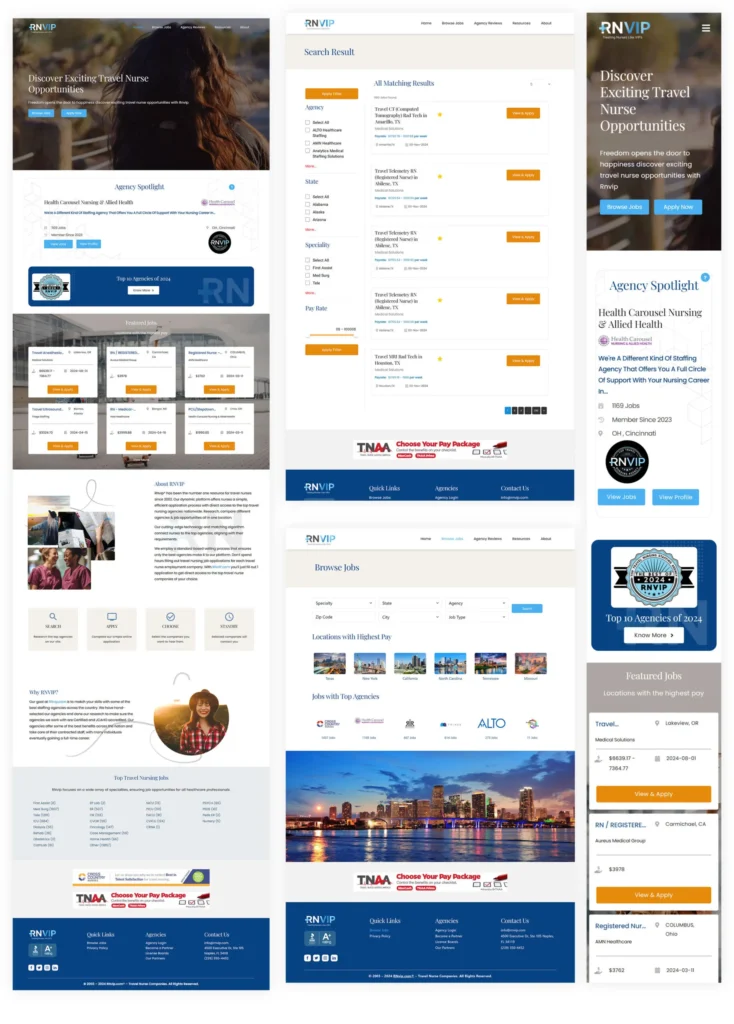
RNVIP — Nationwide Travel-Nurse Marketplace
Why Off-the-Shelf Software Falls Short in Healthcare
01
Rigid EHR integration
bolt-on connectors that break with every EHR vendor update
02
One-size-fits-all scheduling
03
Compliance gaps
generic tools rarely map cleanly to HIPAA’s technical safeguards out of the box
04
Poor interoperability
data trapped in silos between billing, clinical, and patient-facing systems
Custom clinical software solutions solve this by starting from your actual workflow — not a template.
Core Areas of
Healthcare Software Development
EHR & Clinical System Integration
Connecting existing EHR/EMR platforms (Epic, Cerner, athenahealth, and others) with scheduling, billing, and patient engagement tools via HL7/FHIR-based interfaces, so data moves automatically instead of being re-entered by staff.
Physician & Practice Management Tools
Physician software solutions covering appointment scheduling, e-prescribing workflows, clinical documentation support, and referral management — built around how a specific practice actually operates, not a generic template.
Patient Engagement Platforms
Secure patient portals, appointment reminders, intake forms, and telehealth-adjacent tools that reduce no-shows and administrative overhead.
Healthcare Data & Reporting Dashboards
Custom dashboards that pull from multiple clinical and operational systems to give administrators a real-time view of patient flow, billing status, and compliance metrics.
HIPAA-Aligned Architecture
Every healthcare build should be architected around HIPAA’s Security Rule from day one: encryption at rest and in transit, role-based access control, audit logging, and secure hosting — not retrofitted after launch.
What to Look for in a Healthcare Software Consulting Partner.
When evaluating healthcare software consulting services, ask:
At ZonSource, our development practices follow ISO 9001:2015 and ISO 27001:2018-aligned processes for quality management and information security — giving hospitals and practices a documented, auditable foundation for handling sensitive patient data.
Do they understand healthcare workflows, or are they applying generic SaaS patterns to a clinical environment?
Can they show HL7/FHIR integration experience — not just "API integration" in general?
Is security built into their development process, with documented practices around access control and data handling?
Do they offer ongoing support, since healthcare software needs updates as regulations and EHR vendors change?
Build vs. Buy
When Custom Makes Sense
If your practice or hospital system has workflows that don’t map cleanly to a commercial platform, or you’re paying for multiple disconnected tools that don’t talk to each other, custom healthcare software integration usually pays for itself within the first year through reduced admin time and fewer billing errors.
| Scenario | Off-the-Shelf | Custom Build |
|---|---|---|
| Standard scheduling, single location | Often sufficient | Optional |
| Multi-EHR integration | Frequently breaks | Purpose-built |
| Unique clinical workflow | Forces workarounds | Fits exactly |
| Multi-location / multi-specialty | Licensing costs stack up | One system, scales with you |
| Long-term data ownership | Vendor-locked | You own the stack |
How ZonSource Approaches Healthcare Software Projects.
01
Discovery
we map your current clinical and administrative workflows before writing a line of code
02
Architecture
HIPAA-aligned system design, integration points identified upfront
03
Development
iterative builds with staff feedback loops, not a black-box delivery
04
Integration & Testing
EHR/EMR connections tested against real data scenarios
Frequently Asked Questions
Is custom healthcare software HIPAA compliant by default?
No software is “HIPAA compliant” out of the box — compliance depends on how it’s configured, hosted, and operated. What a development partner can do is architect the system to support your HIPAA compliance program: encryption, access controls, audit trails, and secure infrastructure.
How long does a typical healthcare software build take?
Depends on scope — a focused practice management tool can launch in 8-12 weeks, while a full multi-system integration project can run 4-6 months.
Can you integrate with our existing EHR?
Most modern EHR platforms expose HL7 or FHIR-based APIs. We evaluate your specific EHR vendor’s integration capabilities during discovery before scoping the project.
Ready to modernize your
hospital's software stack
Send a brief or book a call. A senior strategist will respond within one business day with a tailored approach.