Manufacturing Software Development Services Buyer's Guide
Manufacturing IT budgets in 2026 are being pulled in three directions at once. Industry 4.0 initiatives promise data-driven production but require IIoT integrations that no single vendor covers. Supply chain resilience programmes need software that connects ERP, WMS, and supplier portals across geographies. Sustainability reporting is now a boardroom priority, and the software to track Scope 3 emissions across a multi-tier supplier network does not exist off the shelf.
Manufacturers who try to solve all three with a single commercial platform typically end up with a mix of expensive licences, awkward integrations, and workflows their operators refuse to use. The alternative — hiring a manufacturing software development team to build the missing 20% around commercial cores — is what this guide covers.
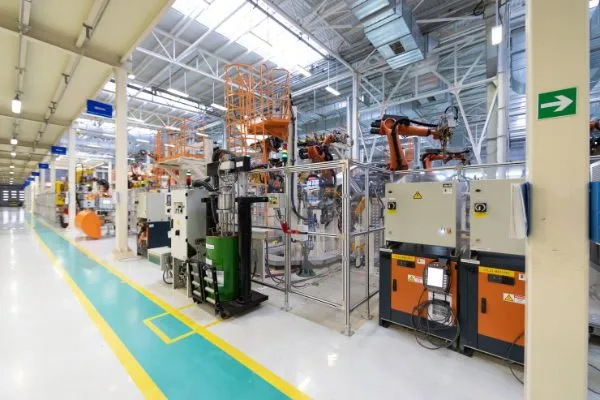
The manufacturing software landscape in 2026.
Modern manufacturing IT is built from six core categories. Understanding where custom development fits requires understanding what each category does well and where it stops.
01
MES (Manufacturing Execution Systems)
MES (Manufacturing Execution Systems) manage the shop floor in real time: work orders, machine states, operator actions, quality checks, and production reporting. Leaders include Rockwell FactoryTalk, Siemens Opcenter, Wonderware, and Tulip. MES is where clinical-grade real-time discipline meets industrial reality. Custom development around MES usually addresses gaps in equipment integrations, plant-specific workflows, or data extraction for analytics.
02
ERP (Enterprise Resource Planning)
ERP (Enterprise Resource Planning) covers finance, procurement, order management, and enterprise-wide reporting. SAP S/4HANA, Oracle NetSuite, Microsoft Dynamics 365, and Infor CloudSuite dominate. ERP customisation is expensive and risky, but integration development between ERP and other systems is where most custom manufacturing software development budgets go.
03
WMS (Warehouse Management Systems)
WMS (Warehouse Management Systems) run receiving, put-away, picking, packing, and shipping. Manhattan Associates, Blue Yonder, Körber, and Oracle WMS are the enterprise choices. NetSuite WMS and Fishbowl serve the mid-market. Custom development around WMS often means picking optimisations, integration with automation (robots, AGVs, sortation), and warehouse-to-yard coordination.
04
PLM (Product Lifecycle Management)
QMS (Quality Management Systems) enforce quality processes and audit trails. MasterControl, ETQ Reliance, Sparta TrackWise, and Veeva Vault Quality lead. Custom QMS development typically means industry-specific inspection workflows, statistical process control extensions, or supplier quality portals.
05
IIoT platforms
IIoT platforms collect and act on machine data. AWS IoT SiteWise, Azure IoT, PTC ThingWorx, GE Proficy, and open-source options like ThingsBoard compete. IIoT is where custom development is most valuable — every plant’s machines, PLCs, and sensor topology is different, so the integration and analytics layer is always bespoke.
What custom development addresses.
Off-the-shelf platforms handle 70-80% of most manufacturers’ needs. The remaining 20-30% is where custom development delivers disproportionate value:

Plant-specific workflows.
Every plant has quirks — a legacy machine that requires manual data entry, a union agreement that dictates specific role assignments, a customer contract that mandates unusual traceability records. Commercial software forces the plant to conform to the software. Custom development lets the software conform to the plant.
Legacy system integrations.
A typical mid-sized manufacturer has 15-30 systems in production, ranging from a 1998 AS/400 to a 2024 SaaS platform. Commercial integration tools cover the modern half. Custom development covers the legacy half.
Equipment connectivity.
Machine data extraction from a 30-year-old CNC controller is not a solved problem in any commercial catalogue. Custom development bridges the OT/IT divide with protocol adapters, edge processing, and standardised data schemas.
Compliance-specific reporting
ISO 9001, IATF 16949 (automotive), AS9100 (aerospace), ISO 13485 (medical devices), and FDA 21 CFR Part 820 all impose reporting requirements that off-the-shelf systems cover generically. Custom development produces the specific reports auditors will accept without argument.
Customer-facing portals.
OEM customers increasingly demand supplier portals with real-time inventory visibility, PO tracking, quality data, and forecast collaboration. Building these portals in-house or via custom development is usually faster and cheaper than the enterprise portal modules from ERP vendors.
Analytics and machine learning.
Predictive maintenance, yield optimisation, energy consumption analytics, and anomaly detection require custom data pipelines and models tuned to the plant’s specific equipment and process signatures.
Message-based integration
API-based integration
File-based integration
GS1 standards
ISO 9001 & 27001 —Certified
Countries Reach
Common pitfalls
Building what commercial software already does. Custom development belongs at the edges. Rebuilding an MES from scratch is almost always a mistake.
Ignoring change management. Operators, planners, and quality engineers must adopt new software for it to deliver value. Budget 20-30% of the project cost for training and workflow redesign.
Underestimating data quality. A shop floor system that receives dirty data will produce dirty outputs. Data cleansing is often 40% of an analytics project.
Deploying without pilot. Never roll out custom manufacturing software to more than one line or one shift without a proven pilot. The cost of a failed rollout in production is measured in shift-hours lost, not developer-hours.
Skipping observability. Manufacturing software must be instrumented from day one. Metrics, logs, and traces are not optional in an environment where an outage stops production.


How ZonSource approaches manufacturing software development
We work primarily with mid-market manufacturers across automotive, industrial equipment, food and beverage, and consumer packaged goods. Our engagements typically start with an architecture assessment that documents the existing landscape and identifies the highest-value integration opportunities. Our engineers have prior experience at automotive Tier 1 suppliers, food-and-beverage plants, and industrial IoT platform vendors, so we bring the vocabulary and shop-floor intuition manufacturers need.
If you are scoping a manufacturing software development project — whether an MES integration, a custom quality portal, a predictive maintenance pipeline, or a customer-facing supplier portal — we would be glad to talk. Book a 30-minute discovery call and we will send our reference architecture for your industry vertical.
Frequently Asked Questions
When should a manufacturer choose custom software development over off-the-shelf?
Choose custom when the requirement is a genuine competitive differentiator, when no commercial product covers your regulatory or workflow specifics, or when integration between existing systems is more critical than the systems themselves. Choose off-the-shelf when the requirement is a commodity capability that competitors also need.
How much does custom manufacturing software development cost?
Integration projects between existing systems typically run $100,000-500,000. Custom applications (portals, quality tools, analytics dashboards) run $250,000-1.5M. Bespoke MES or WMS implementations start at $2M and can exceed $10M. Prices vary considerably by region, complexity, and integration count.
How long does manufacturing software development take?
A focused integration project takes 3-6 months. A custom application typically takes 6-12 months from kickoff to go-live. A bespoke MES or full production system takes 18-36 months. Plan for a pilot phase of 60-90 days before broad rollout.
What technology stacks are common in modern manufacturing software?
Backend: Python, Java, C#/.NET, and Node.js dominate. Real-time messaging: Kafka, MQTT, RabbitMQ. Databases: PostgreSQL, TimescaleDB, InfluxDB for time-series, Snowflake or Databricks for analytics. Cloud: AWS IoT services, Azure IoT Hub, GCP IoT Core. Edge: NVIDIA Jetson, Advantech, Siemens IPC platforms.