Design people understand
without a tutorial.
We design interfaces for web, mobile and SaaS products — research, wireframes, visual UI and usability testing — so the first-time experience doesn’t need an explanation. Senior product designers, fixed scope, design your engineering team can actually build from.
180+ teams shipping with our engineers · ISO 27001-secure · NDA on request
— What we build
Four ways we design
your product.
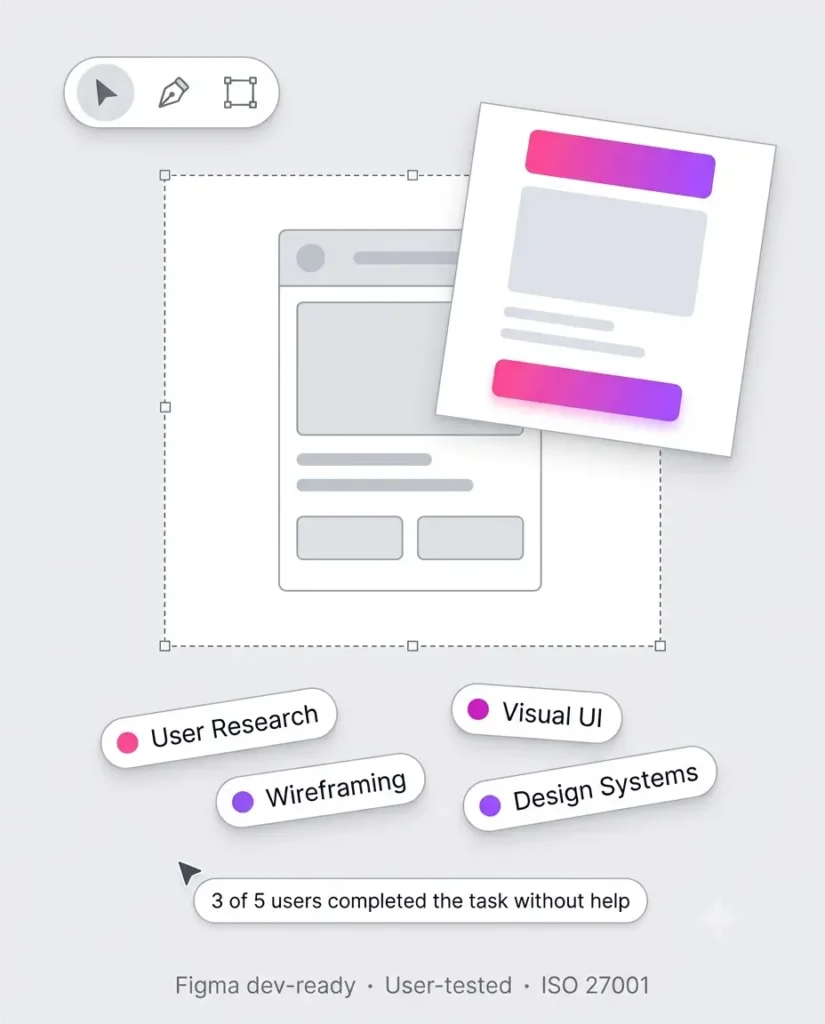
From a first user research pass to a full design system, we design the experience that matches your product’s actual complexity.
User research & discovery
Interviews, usability testing and journey mapping so design decisions are based on real users, not assumptions.
User interviews
Journey mapping
Usability testing
Wireframing & information architecture
Structure and flow defined before visual design starts, so the product makes sense before it looks good.
Wireframes
User flows
Information architecture
Visual UI design
Polished, on-brand interfaces — typography, color, layout — designed for clarity first, decoration second.
UI design
Visual design
Brand-aligned
Design systems & handoff
Reusable components and documented specs so design stays consistent and engineering can build without guessing.
Design systems
Figma dev mode
Component libraries
- Featured · Designed to be built, not just admired
Most redesigns fail because nobody tested the first draft on a real user.
Most “we redesigned it and users still struggle” situations happen because design decisions were validated by internal opinion, not real usability testing — so problems only surface after launch, when they’re expensive to fix. Before we finalize anything, we test with real users on low-fidelity wireframes, when changes are still cheap — so the polished version ships already validated.
User-tested
Validated before build
Dev-ready handoff
Not just internal opinion
1
RESEARCH
Understand real users & their actual needs
2
STRUCTURE
Wireframe flows & information architecture
3
DESIGN
Visual UI, tested and refined with real users
Outcome
We start with real user research — so design decisions are validated before engineering builds them, not after.
14 YEARS · 300+ APPS SHIPPED
Built to move revenue,
not just impressions.
14+
In business
Since 2012
300+
Products
95%
Clients renew
after the first contract
ISO
Audited
Data security





Capabilities & stack
Boring tech that
ships on time.
We design with proven, widely-adopted tools and a process built for handoff — not a beautiful file only the original designer can interpret. Real specs, buildable by any engineer.
How we pick
01
Research before designing
Before we open a design tool, we understand who’s actually using this and what they’re trying to do — assumptions get tested, not assumed.
02
Structure before polish
Wireframes and information architecture come first, so the product’s logic is right before visual design invests time in the wrong structure.
03
Test with real users, not just internally
Usability testing happens on low-fidelity work first, when changes are cheap — not after the polished version is already built.
04
Design for handoff, not just for Figma
Every design ships with documented components, states and specs — so engineering can build it without guessing or a dozen follow-up questions.
DESIGN TOOLS
Figma
Figma Dev Mode
FigJam
Adobe Creative Suite
RESEARCH & TESTING
UserTesting
Maze
Hotjar
Lookback
PROTOTYPING
Figma prototyping
Principle
interactive click-through prototypes
DESIGN SYSTEMS
Component libraries
Design tokens
Storybook integration
HANDOFF & COLLABORATION
Figma Dev Mode
Zeplin
design QA collaboration with engineering
Industries
UI/UX design,
tuned for your industry.
Every industry has its own users, accessibility requirements and trust expectations. We bring playbooks, not generic templates — and shape design to your users from day one.
Healthcare
Design for patients and clinicians under real pressure.
- Accessible design for patient-facing portals and forms
- Clinician-facing UI designed for speed under time pressure
- Usability testing with real patient and provider users
Finance & Fintech
Design that builds trust with money-related decisions.
- Clear, trust-building UI for financial and banking flows
- Complex data visualization made understandable
- Accessibility and compliance-aware design patterns
Retail & E-commerce
Design that turns browsing into checkout.
- Conversion-focused product and checkout flow design
- Mobile-first design for how people actually shop
- Usability testing to reduce cart abandonment
Logistics
Design for field and dispatch use, not just the office.
- Rugged, glanceable UI for field and driver-facing apps
- Dashboard design for dispatch and ops teams under pressure
- Usability testing in real operational conditions
Engagement models
Pick how you
want to Ship with us.
Three ways in — all senior product designers, all fixed against the usability outcome we agree on before the first wireframe.
MVP
Design audit & research
Best when you have a product but aren’t sure why users struggle with it.
- Fixed price, 1–2 weeks
- Usability audit and user research findings
- A prioritized design roadmap
Most popular
Fixed-scope
Project-based build
Best for a defined product needing full design work.
- Scope → dev-ready handoff in 6–14 weeks
- Fixed scope, fixed price — no hourly drift
- Research, wireframes, UI and usability testing included
- Full design system & dev-ready handoff
Embedded
Staff augmentation
Plug senior product designers into your team.
- 8+ yr average, hand-picked, never on a bench
- Research, UI, and design systems skills
- Direct line to your product or engineering lead
FAQ
The questions everyone asks before kickoff.
Not sure if you need research, a redesign, or just a design system? Book a 30-min call with a senior product designer.
What's the difference between UI and UX design?
UX (user experience) covers research, information architecture and user flows — how the product works and makes sense. UI (user interface) covers the visual design — how it looks and feels. Good design needs both, but they’re genuinely different disciplines, and we scope work based on which one your product actually needs more of.
We have a product already — do we need full research, or just a visual refresh?
Depends on the actual problem. If users are confused or dropping off, that’s usually a UX/structural issue research would uncover. If the product works but looks dated, that’s more of a visual UI refresh. Our design audit tells you which one you actually need.
Can you design without doing user research first?
We can, but we recommend against skipping it for anything beyond a small change — design decisions based on internal opinion rather than real user behavior are the most common reason redesigns don’t actually improve usability.
Will the design be ready for our engineers to build, or will there be a lot of back-and-forth?
We design specifically for handoff — documented components, states and specs in Figma Dev Mode — to minimize the guessing and follow-up questions that come from a design file that was never meant to be implemented literally.
Do you design a whole product at once, or can we start smaller?
Either — a full product design engagement makes sense for a new build, but we also take on smaller scopes like a single flow, a design system foundation, or a targeted usability fix for an existing product.
How do you test designs with real users before the product is built?
We test on low-fidelity wireframes and interactive prototypes — real users complete real tasks, and we watch where they get confused — so problems are caught and fixed while changes are still cheap, before a single line of code is written.
Can you design a system that stays consistent as we add more features over time?
Yes — a design system with documented, reusable components is exactly for this, so new features stay visually and functionally consistent without redesigning from scratch every time.
Who owns the design files and design system after the project?
You own everything — Figma files, design system documentation, and specs, with no vendor lock-in. Your team or the next designer can pick up and extend the work.
ISO 27001-secure · Certified since 2020
Let's design something people understand instantly.
Send your brief — a senior product designer (not a sales rep) replies within 24 hours with a read on your product’s usability, and a fixed-scope plan for the design work.
- A 30-min scoping call with a senior product designer
- A usability read on your current product
- A research and design plan
- A design system and dev-ready handoff — yours to keep