Manufacturing Software Development: What Custom Builds Actually Solve
Manufacturing Software Development Services Buyer’s Guide Manufacturing IT budgets in 2026 are being pulled in three directions at once. Industry 4.0 initiatives…
Read More →Explore our insights on custom software development — from bespoke web applications and enterprise tools to workflow automation and API integrations. At ZonSource IT Solutions, we build tailored software that fits your exact business needs, eliminates inefficiencies, and scales as you grow. Browse articles covering development best practices, technology stack selection, cost planning, and real-world project case studies to help you make informed decisions for your next software project.
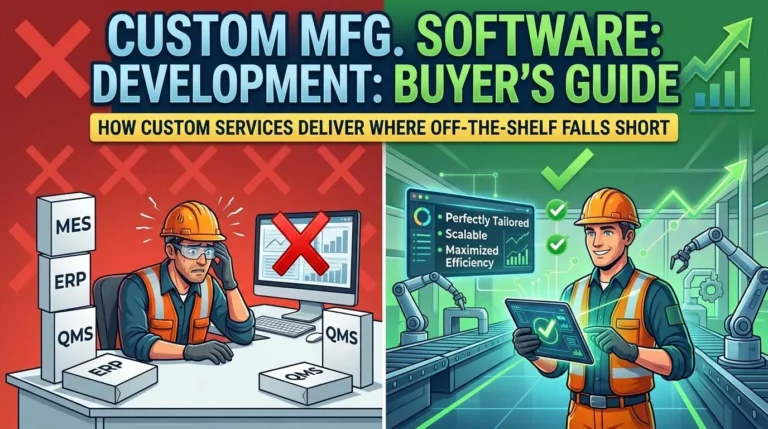
Manufacturing Software Development Services Buyer’s Guide Manufacturing IT budgets in 2026 are being pulled in three directions at once. Industry 4.0 initiatives…
Read More →Custom software development is the process of designing and building software around a specific business need, rather than adapting a general-purpose product. Companies choose custom software when off-the-shelf tools force them to change how they work, when several tools need to behave as one system, or when the software itself is part of what they sell. The guides in this category cover the decisions before and after the build: whether custom is the right choice, how to scope a project, how to choose a development partner, what to plan for after launch, and how to modernise systems that already exist.
Off-the-shelf software is often the right first choice. It is quicker to start, usually cheaper at the beginning and supported by a large user base. Custom software becomes worth considering when your process is unusual enough that workarounds cost more than building would, when several existing tools must share data and cannot, or when the software gives the business an advantage that a shared product cannot provide.
A simple test helps. List the five tasks your team repeats most often, and count how many depend on a spreadsheet, a manual step or a second system. If that number is high and the tasks sit close to revenue or service delivery, a custom solution deserves a serious look.
Most custom software projects that struggle do so because the scope was unclear at the start. A good discovery phase answers three questions: what problem the software must solve, who will use it and how often, and what success looks like in measurable terms. Write the answers down. Describe the main workflows step by step, including the exceptions, because exceptions are where estimates usually go wrong.
Agree on a first release that delivers real value on its own, and plan later releases separately. A smaller first version can be tested with real users early, and the evidence it produces makes the next decisions far easier.
Teams usually choose between three models. A fixed-scope project suits well-defined problems with stable requirements. A dedicated team working in sprints suits products that will keep changing. A hybrid model, with a fixed first phase followed by ongoing development, often works best for businesses that need a clear first release and a longer roadmap.
Whichever model you choose, insist on working software at regular intervals, a backlog you can read at any time, and access to the code repository from the first week. Visibility is the best early warning system a project has.
Custom software rarely stands alone. It usually needs to read from and write to existing systems such as accounting, ERP, CRM, inventory or identity providers. Before development starts, map those connections: which system owns each piece of data, how changes move between systems, and what happens when two systems disagree.
Architecture decisions made early affect cost and flexibility for years. Keep the design as simple as the problem allows. Many business applications do not need a complex distributed setup, and adding complexity before it is needed makes every later change slower.
Custom software often handles customer records, financial data or internal documents, so security belongs in the design from the beginning. Cover authentication and role-based access, encryption in transit and at rest, logging of important actions, and a backup and recovery process that has been tested rather than assumed.
Identify compliance obligations early. Data protection rules such as GDPR, sector rules for healthcare or finance, and the requirements written into client contracts all shape where data is stored and how it is handled. Confirming them during discovery is far cheaper than retrofitting them after launch.
Quality comes from testing at several levels. Automated tests check the logic of key functions. Integration tests confirm that connected systems exchange data correctly. User acceptance testing confirms that the people who will use the software can complete their work. Ask any development partner how they test before release, how bugs are tracked, and how regression tests protect existing features when new ones are added.
Software needs attention after launch. Dependencies need updates, security patches must be applied and business rules change over time. Budget for maintenance from the start, and treat it as a planned cost rather than a surprise.
Agree on ownership before development begins: who owns the source code, the documentation and the data, and how knowledge transfers if the team changes. Good documentation covers the architecture, setup, deployment steps and the reasons behind major decisions, so someone who did not build the system can still maintain it.
Many businesses do not need brand-new software. They need an older system made to work with current tools, or moved to a platform that can still be maintained safely. Modernisation usually starts with an inventory of what the existing system does, which features are actually used, and where it creates the most risk or cost.
Some parts can be wrapped with new interfaces while others are replaced in stages. A phased approach reduces disruption, because the business keeps operating while each new component is proven in use.
Look for a partner that asks about your business before proposing a technology stack. Ask for examples of similar work, how scope changes are handled, how the work is documented and who would be on your team. A named point of contact, regular demos and clear written assumptions are stronger signs than a long list of technologies.
Compare proposals on assumptions and risks as well as price. The lowest estimate is often the one that left the hardest parts out. If you are looking for dedicated engineers to add to an existing team, our hire developers page explains the options.
If you are early in your planning, begin with the sections on deciding whether custom is right and on scoping the first release. If you already have software that needs work, read the guidance on integrations and modernisation. If you are ready to build, use the discovery questions above as the agenda for your first meeting with a partner.
Not sure whether custom software is the right answer? Tell us the process you want to improve, the tools involved and the outcome you need. We will explain what we would recommend and what it would involve. Contact us to start the conversation.
Tell us the process you want to improve, the tools involved and the outcome you need. We will explain what we would recommend and what it would involve.
Get a Free Consultation