Dedicated Team vs Staff Augmentation vs Project: Which Fits?
Dedicated Team vs Staff Augmentation vs Project Model Dedicated Team vs Staff Augmentation vs Project Model: Which Fits? Short answer: Choose staff…
Read More →Practical guides to what software development costs and how to plan a budget before you hire. Start with the engagement model that fits your project, then compare team setups and delivery options for US and India teams.
Read our guide to dedicated team vs staff augmentation vs project model to see which model fits your scope and budget, then request a custom quote for your project.
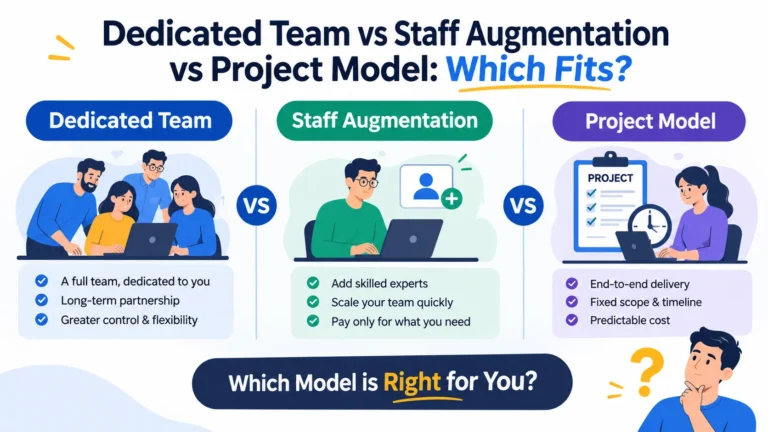
Dedicated Team vs Staff Augmentation vs Project Model Dedicated Team vs Staff Augmentation vs Project Model: Which Fits? Short answer: Choose staff…
Read More →Software development cost is the total amount a business spends to plan, build, launch and maintain a software product. The hourly rate of the people doing the work is only one part of that total. Scope, team setup, location, integrations, testing, security and the years of maintenance that follow all shape the final figure. The guides in this category help you understand those drivers, compare engagement models and budget for the full life of the software, so you can judge a quote on its real merits rather than on its headline number.
Scope is the largest driver. Each feature, user role, screen and workflow adds design, development and testing effort. A focused tool that does one job well costs far less than a platform with dozens of modules, even if both use the same technology. Integrations add cost quickly, because each connection to an accounting, CRM, payment or identity system needs its own design, error handling and testing.
Other drivers include the complexity of the data model, performance and scale requirements, security and compliance obligations, and the number of platforms the product must support, such as web, iOS and Android. Each of these can be estimated during discovery. Projects that skip discovery tend to produce quotes that look low at the start and rise sharply during the build.
The way a team is engaged changes how cost is spent. A fixed-scope project gives a defined price for a defined set of outputs. It suits well-understood problems with stable requirements, but any change request usually triggers a new estimate. A dedicated team bills for a continuing group of developers working on your product, which suits products that will keep evolving. Staff augmentation adds individual engineers to your existing team, so your own managers keep control of priorities and day-to-day direction.
Each model has different cost behaviour. Fixed-scope projects are easier to budget but less flexible. Dedicated teams are more flexible but require strong product ownership on your side, because unclear priorities waste paid hours. Staff augmentation works well when you already have a delivery process and need specific skills, and it becomes expensive when your team cannot direct the work effectively. Choose the model that matches how much the requirements are likely to change.
Team location affects hourly rates, but rate alone does not decide total cost. A lower-rate team that needs more hours, more rework or more management time may cost more in the end. Time-zone overlap, English fluency in written communication, and the seniority mix of the team all change how efficiently the work gets done. A blended team, with senior engineers setting architecture and quality standards, often delivers better value than a team made up entirely of junior developers.
When comparing quotes from different regions, ask each provider for the same information: team size, seniority, working hours, the hours assumed for testing and project management, and the process for changes. Quotes that look different on the surface often become comparable once these assumptions are written down.
Headline estimates often leave out costs that appear later. Discovery and design work takes time before development starts. Quality assurance is sometimes treated as an afterthought, even though it prevents expensive defects after launch. Data migration, third-party licences, hosting, monitoring and security reviews all need budget. Internal time matters too: product owners, subject-matter experts and stakeholders spend hours on reviews, decisions and testing.
Maintenance is the cost most often underestimated. Software needs security patches, dependency updates, performance tuning and changes when business rules or connected systems change. As a planning guide, treat ongoing maintenance as a recurring cost for as long as the product is in use, and agree on it before the build starts.
A sound budget is built in stages. Start with a discovery phase that defines the problem, the users and the first release. Use that output to estimate the build, then add budget for testing, launch, integrations and a contingency for unknowns. Many teams set aside a meaningful percentage of the build cost as contingency, because requirements almost always become clearer during development, and some of that learning changes the plan.
Release in increments where possible. A first version that delivers real value to real users provides evidence for the next investment. It also limits the money at risk if the initial assumptions prove wrong. Each release should have its own budget, scope and success measures.
The cheapest quote is often the one that left the hardest parts out. Compare proposals on assumptions and risks as well as price. Check whether each quote includes discovery, testing, integrations, documentation, deployment and post-launch support. Ask how changes are priced, how many revisions are included, and who owns the code and data at the end. A proposal that answers these questions clearly is usually more reliable than one with a lower number and vague scope.
Ask for examples of similar projects, a named team structure and a description of how progress is reported. Regular demonstrations, a readable backlog and access to the code repository from the first weeks are good signs that a team expects to be measured on working software.
Cost can be reduced without weakening the product. Keep the first release focused on the essential workflows and move nice-to-have features to later phases. Reuse existing services and components rather than building everything from scratch. Write requirements precisely, because clear requirements prevent rework. Automate testing where it pays back, and make decisions quickly so developers are not waiting on answers.
Avoid cutting discovery, security or documentation to save money at the start. Those activities cost less than the rework they prevent, and they protect the investment over the life of the product.
If you are early in planning, define the problem, list the users and write down the first release in plain language. Then decide which engagement model fits how much you expect the requirements to change. If you already have a team and need specific engineers, our hire developers page explains how dedicated developers can join your delivery process. For a project-specific estimate, contact us with your requirements, and we will explain the cost drivers and what a realistic budget would include.
Not sure where your budget should start? Tell us the problem you want to solve, the users involved and the systems the software must connect to. We will explain what we would recommend and what it would involve.
Tell us the problem you want to solve, the users involved and the systems the software must connect to. We will explain the cost drivers and what a realistic budget would include.
Get a Free Consultation